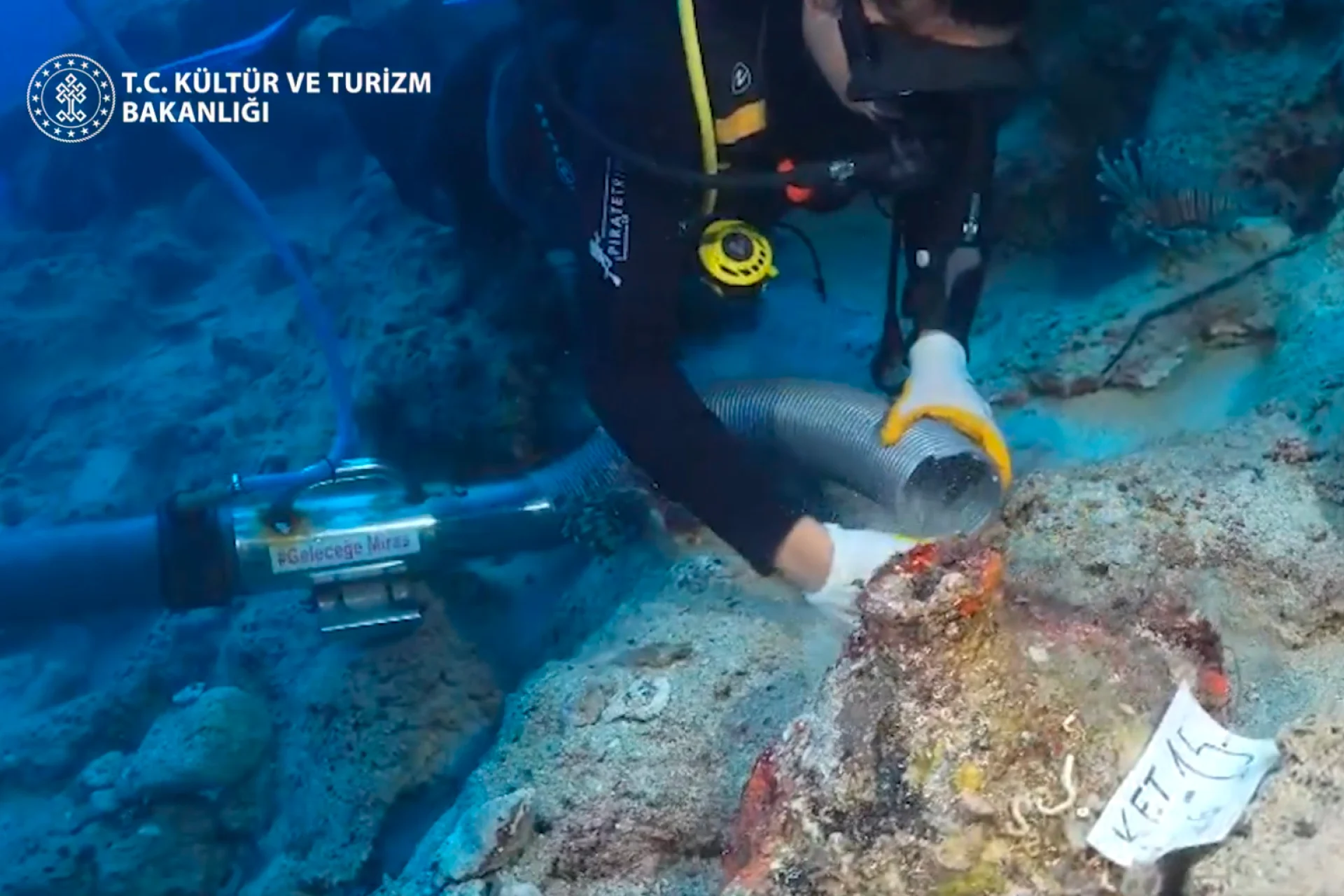
Marine archaeologists have encountered yet another ancient shipwreck, this time in Kekova, southwestern Türkiye. This particular discovery might be the world’s oldest shipwreck—carrying relics from the Early Bronze Age, roughly between 4,400 and 4,700 years ago.
Mehmet Nuri Ersoy, Türkiye’s minister of culture and tourism, detailed the find in a social media post earlier today. According to Ersoy, the amphorae unearthed during the investigations likely carried olive oil or wine and shed more light on regional maritime trade from thousands of years ago. The ship was discovered in 2024 and first described in a preliminary report published this past July in the Journal of Maritime Archaeology by lead investigator Hakan Öniz, an archaeologist at Akdeniz University, Türkiye. Key details about the find are only coming to light now.
As the ship’s wooden elements weren’t preserved, the team wasn’t able to conduct radiocarbon dating. However, the style of the ship’s cargo strongly suggests that it sank sometime during the Early Bronze Age. If true, the Kekova vessel would be the oldest known shipwreck in the world.
“We continue to illuminate the history of Anatolia’s maritime trade with new findings and to pass on our cultural heritage underwater to future generations,” Ersoy remarked in his post.
According to the preliminary report, in the past 15 years authorities have recorded a whopping 420 shipwrecks of “archaeological significance” along Türkiye’s Mediterranean coasts. Most of these are from the Roman and Byzantine periods, and just three—including the Kekova shipwreck—can be attributed to the Bronze Age.
Source link