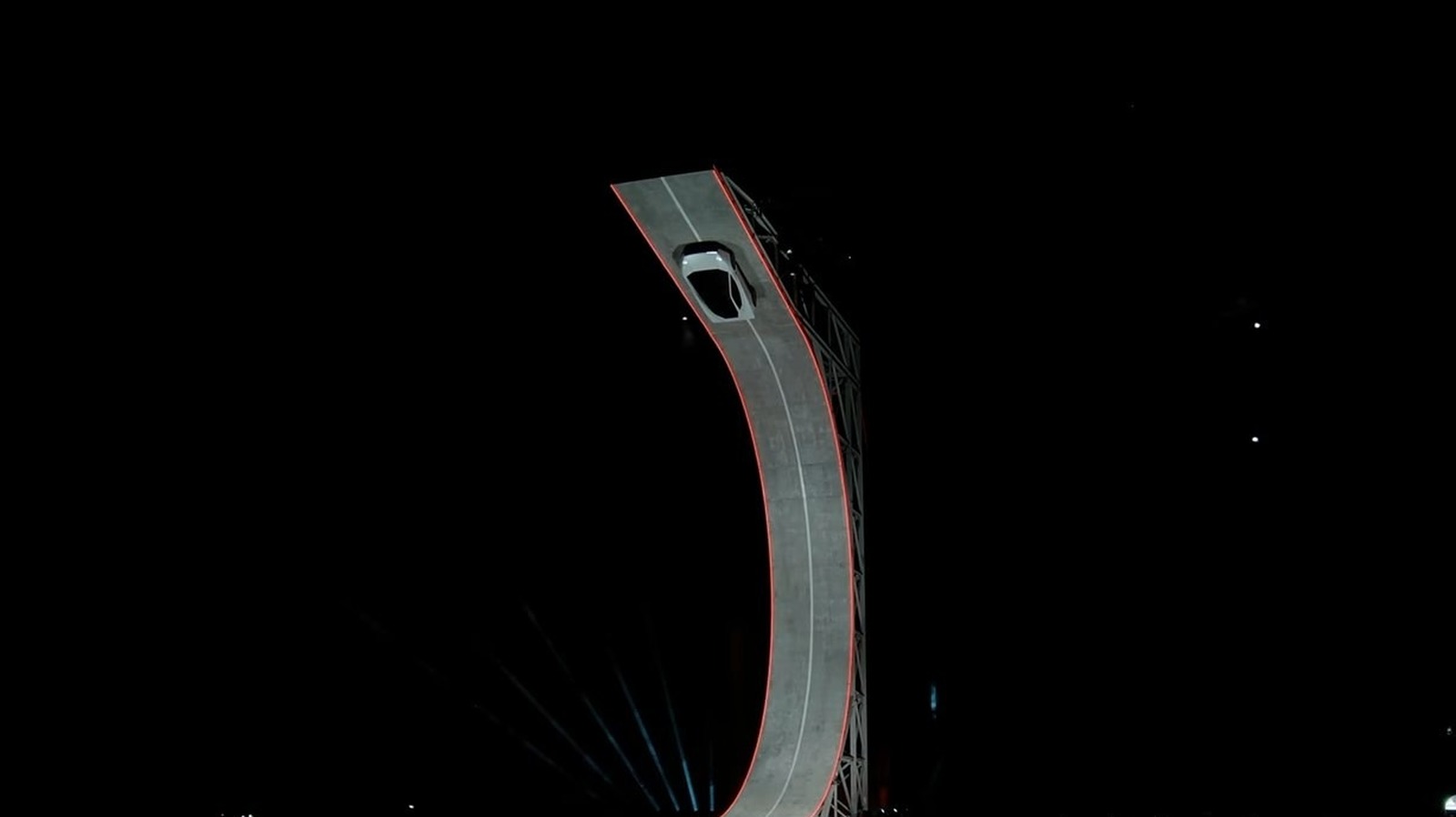
Tesla demonstrated the long-awaited next-gen Roadster with some wild stunts, starting with making the car drive up a C-shaped ramp and stop in the middle of the part perpendicular to the ground. It drove slow enough and stopped long enough to make it look like it was hanging upside down. After that, the Roadster jumped off the ramp, flipped itself upright, floated a bit and landed safely on the ground.
On its website, Tesla explained that the Roadster defied gravity by using a multi-mode fan and ground sealing system that acts as a "downforce generator." It pulls air from underneath the vehicle and provides the suction needed to hold the car upside down, at any speed. The automaker says those powered fans, along with the vehicle's retractable rear wing, provide the necessary downforce, or the force that pushes a vehicle into the ground.
The new Roadster, however, isn't the first car that uses a fan system to generate downforce. When Tesla unveiled the Roadster, McMurtry Automotive responded with a cheeky "Welcome to the club" on Instagram, with a video of its Spéirling hanging upside down from a platform. McMurtry's suction technology called Downforce-on-Demand has two fans that suck air out from under the car. And even before Spéirling, other vehicles have employed fans for downforce.
Way back in 1970, American racing drivers Jim Hall and Hap Sharp entered the Can-Am Championship series with a car that looked like a box with wheels. 6-liter Chevrolet V8 engine. According to Revs Institute Automedia , the vehicle's suction technology started as the "Suspension Test Vehicle" project at Chevrolet, until Hall asked its developer Don Gates to join his team.
Source link