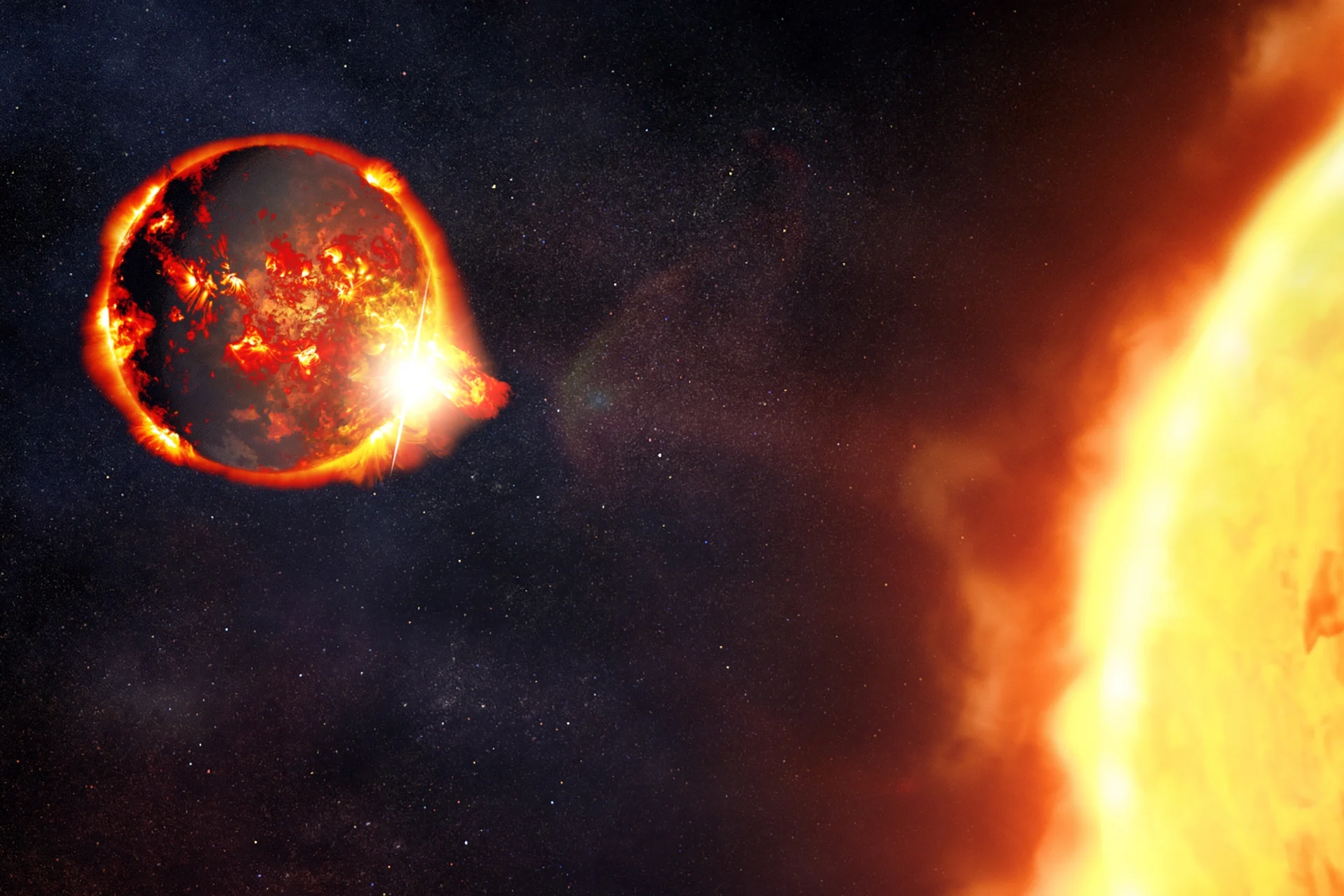
Our Sun is just like any other star. That is, eventually the Sun will run out of fuel and effectively collapse—taking out, presumably, most things in our neighborhood. That won’t pose a problem for those of us alive right now, but for those of you who still care: Scientists think the doomsday for outer planets might come earlier than expected.
New calculations indicate that, once the Sun transforms into a white dwarf some 7 to 8 billion years from now, the outer solar system has roughly 1 billion years left—much lower than previous estimates ranging from 100 billion to a whopping 1 quintillion years, according to a recent study published in The Astrophysical Journal Letters. The latter number was so large as it assumed the Sun would lose its mass in a relatively smooth manner, Konstantin Batygin, the study’s first author, explained to Gizmodo. In reality, the Sun’s death will likely be bumpier, which introduces more chaos to the equation.
“What we’ve shown is that this timeline [of 1 quintillion years] gets front-run by the Sun’s own death,” said Batygin, an astrophyscist at the California Institute of Technology. “Because planetary dynamics is chaotic—exhibiting sensitive dependence on initial conditions—no single simulation tells you what will happen, only what could happen.”
According to Batygin, the stability of the solar system depends on whether its planets travel in “well-ordered, non-intersecting orbits” on astronomical timescales. This is determined by factors such as the spacing between orbits or the web of orbital resonance among the planets.
Source link