We’ve been promised flying cars for decades. We finally have one. Well, sort of.
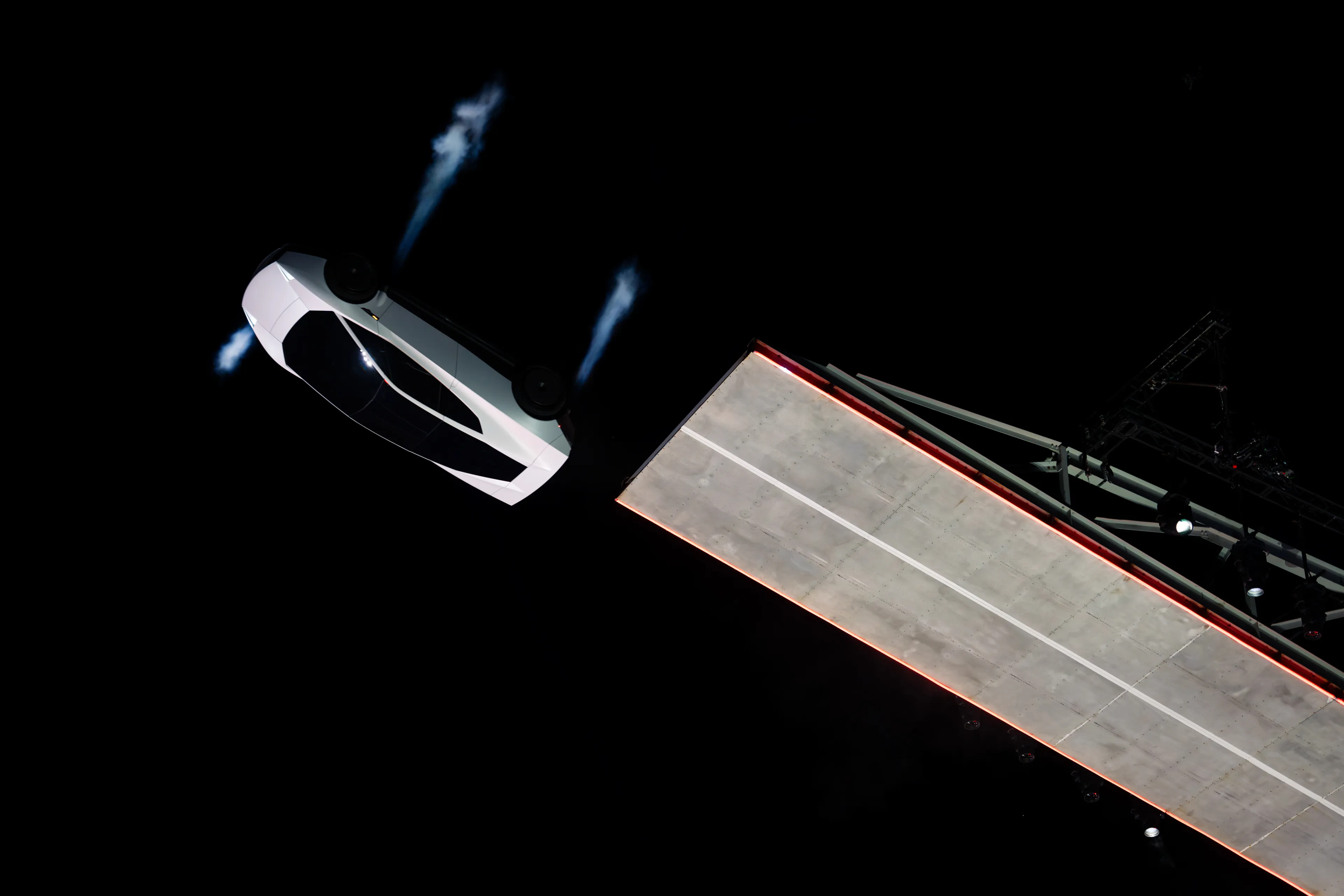
Last week, Elon Musk revealed Tesla’s long-delayed Roadster 2 with a few bells and whistles. The car flies—but not for very long—and the prototype also did a few other things normal cars can’t, like driving up a vertical wall and jumping over Tesla’s entire lineup of vehicles.
This raises two questions: Should we let humans drive up walls and into the air? Given their trouble navigating two-dimensional roads, this seems like an obvious no. But that’s one for lawyers and the Federal Aviation Administration to figure out. The other question is, how did the Roadster 2 prototype do this stuff? We can answer that ourselves, with physics.
Let’s start with how the car drove up a circular ramp and then stayed glued to it Spider-Man–style, completely upside down. I don't think you should ever do this, but this feature of the Roadster 2 can actually improve performance on normal roads. It has to do with friction.
When two surfaces interact—like rubber tires and a road—there can be a force that prevents the surfaces from sliding relative to one another. This interaction is called static friction. We have a simple model for this static friction force where the magnitude (Ff) depends on how hard the two surfaces are pushed together (FN) and the two types of surfaces (μ).
The force pushing the surfaces together is often called the “normal” force, since it's perpendicular to both surfaces.
Source link