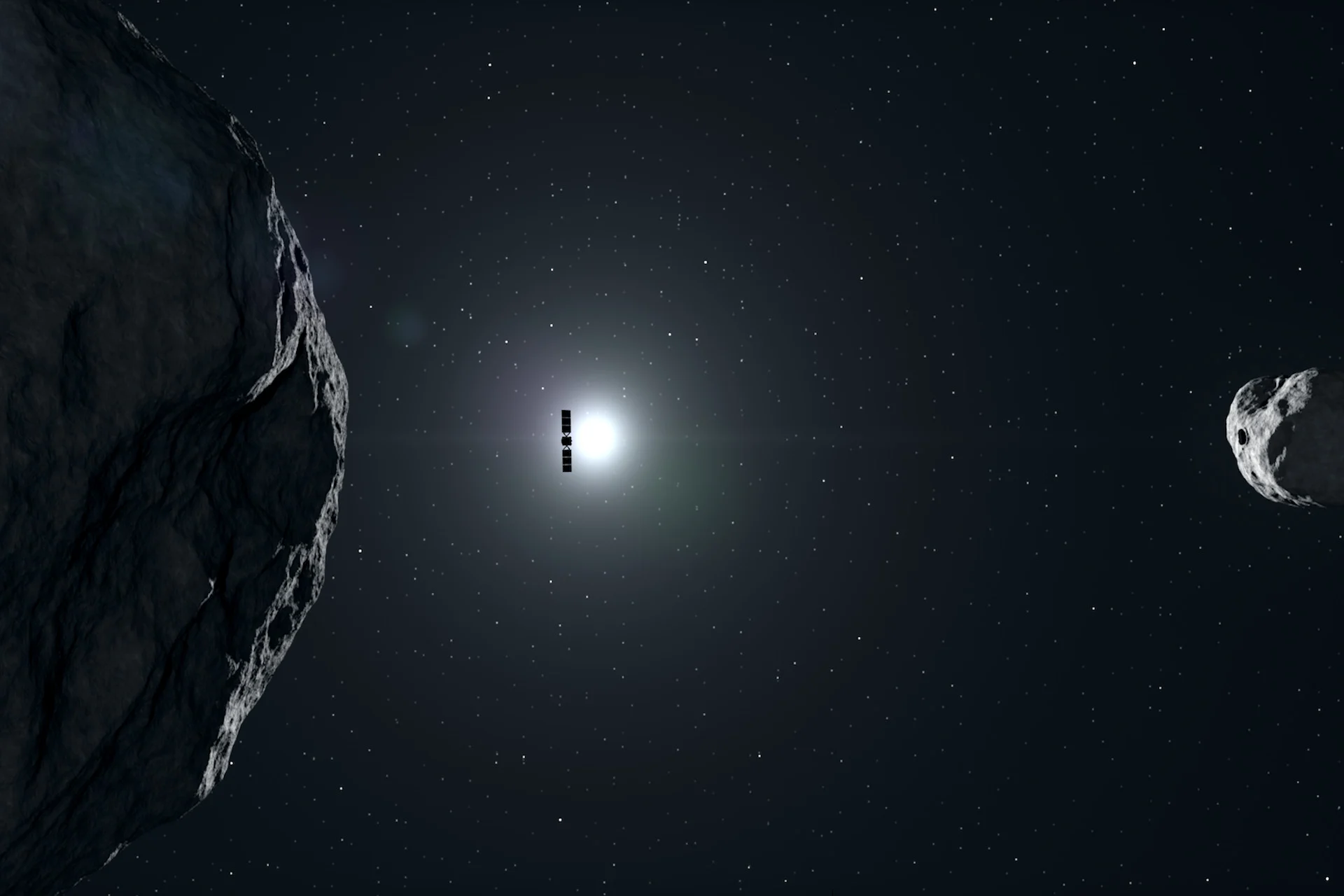
In September 2022, a NASA spacecraft violently smashed into a tiny asteroid as a test of planetary defense. Now, a new probe is ready to check out the wreckage by rendezvousing with the space rock for a closer look.
The European Space Agency (ESA) launched its Hera mission on October 7, 2024, as a crucial follow-up to NASA’s DART (Double Asteroid Redirection Test), a first-of-its-kind attempt to redirect the orbit of an asteroid. The small, car-sized spacecraft recently pulled off a braking maneuver to slow it down as it approaches the binary asteroid system before it makes its first close flyby in early November.
Hera is set to perform a detailed, post-impact survey with the aim of turning a one-time, space experiment into a well-understood planetary defense mechanism. The mission could also help scientists learn more about how asteroids form.
For the DART test, NASA sent a 1,340-pound spacecraft (607 kilograms) and smashed it into Dimorphos, a 558-foot-wide (170-meter) space rock that orbits its larger 2,625-foot-wide (800-meter) companion, Didymos. Ground-based observations revealed that, following the collision, Dimorphos’s orbital period around Didymos shortened from 11 hours and 55 minutes to 11 hours and 23 minutes.
The mission was deemed a success, demonstrating that a spacecraft could deliberately alter an asteroid’s motion. But successfully hitting an asteroid and understanding exactly what that impact did are two different things. To understand the full consequences of the impact, scientists needed a closer investigation.
That’s where Hera comes in, armed with a suite of science instruments to inspect the asteroid after the collision and investigate whether DART’s success can be turned into a dependable strategy for protecting Earth.
Source link