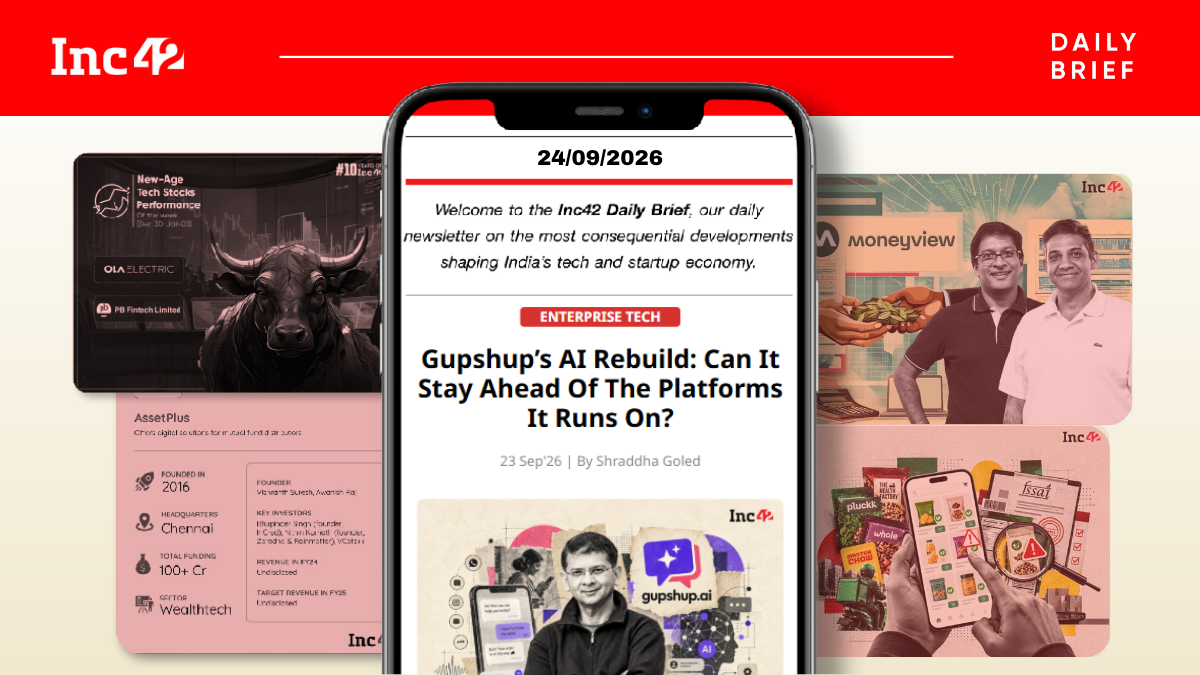
Gupshup is betting on AI for its next growth phase. Leveraging its massive enterprise footprint, the SaaS giant is deploying voice AI agents and model-agnostic integrations to reshape its tech stack to build an AI-first conversational platform. But can it outpace its nimble, AI-native rivals?
Gupshup’s AI Deck: The SaaS platform’s AI stack spans self-serve voice agents for support and operations and Super Agent, an orchestration layer unifying messaging, campaigns, CRM and analytics via natural-language commands. The platform is model-agnostic, while Superclaw enables on-device deployment. These AI and advanced orchestration products now contribute roughly 25% of revenue, growing faster than the legacy messaging vertical.
The Enterprise Moat: Gupshup serves over 50,000 businesses across 130 countries, processing 120 Bn messages annually. The startup leverages these existing relationships and transaction volumes as a competitive edge that AI-native rivals lack. Combined with voice infrastructure and enterprise integrations, this deep integration also allows the platform to drive higher revenue per user as more and more clients adopt custom AI agents.
Gupshup’s IPO Test: The SaaS giant is also evaluating redomiciling to India and is eyeing a potential local listing in the next 12-24 months. Against this backdrop, Gupshup must prove that AI is driving higher revenue per customer, better margins and stronger retention – not just adding products. Investors will scrutinise whether its incumbency translates into a defensible, scalable AI moat.
The Many Pitfalls: Yet, Gupshup continues to douse fires on multiple fronts. Meta’s Business Agent and Jio’s RCS push (with Apple) threaten to commoditise infrastructure and encroach on its application layer.
Source link