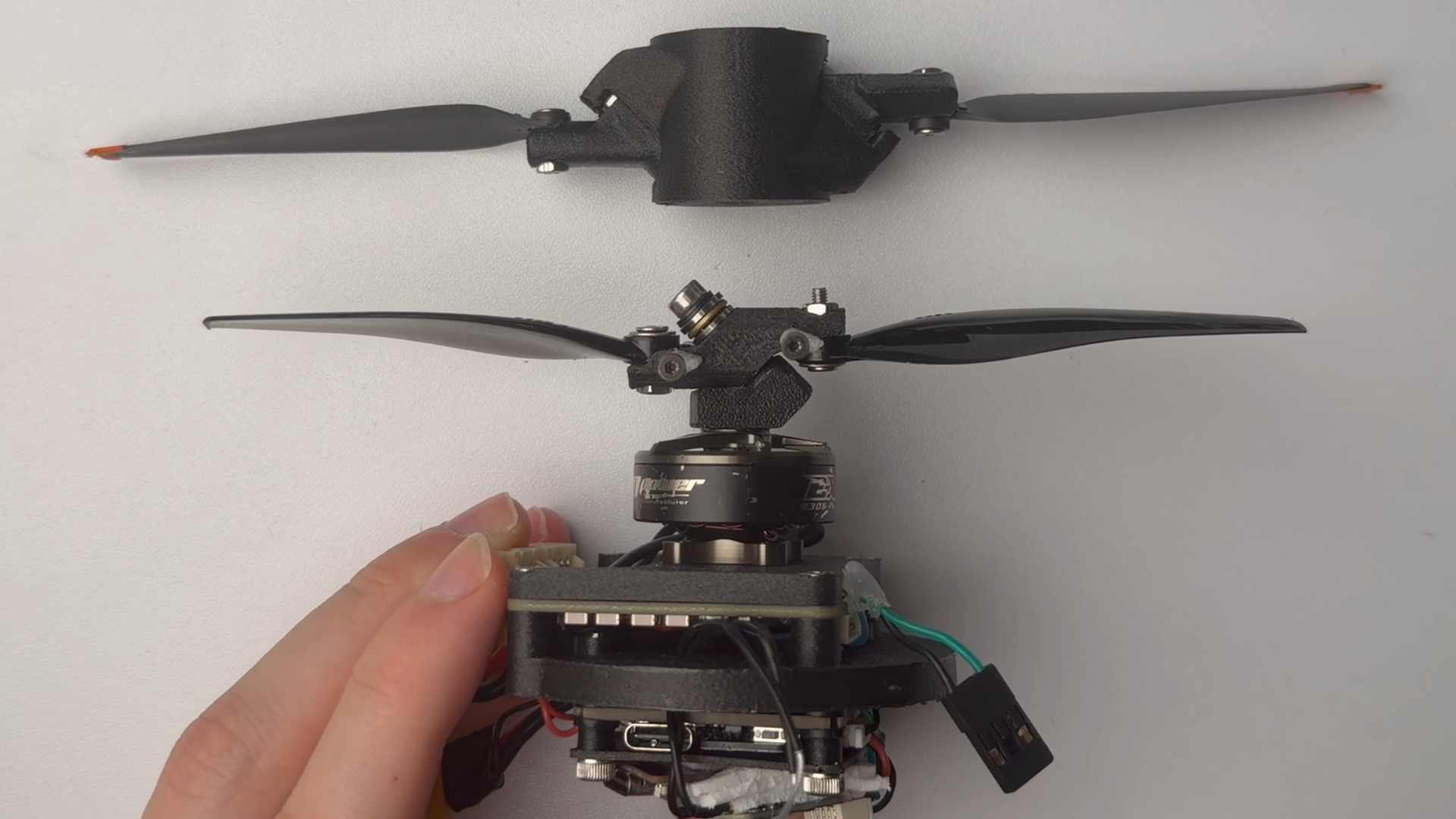
A software engineer who’s also into drones and 3D printing has shared a single-motor drone that they built inside their home and tested on their bed. Joshua Bird shared a video of how they created it on YouTube, highlighting the unique technique they used to maintain controllability and stability. The design used a combination of a hinged propeller, rapid changes to the motor’s rotation speed, and a custom flight controller and motor controller firmware that allowed the motor to react to necessary changes in under 0.2 milliseconds.
Most rotary wing aircraft require a mechanism to counteract the torque generated by the motor or engine and to change its flight direction, typically with the use of a swash plate to change rotor disk attitude and a secondary propeller. While this method has been effective for decades, it has made rotary-wing aircraft heavier and more complex. This single-motor drone cut the need for a secondary mechanism by constantly adjusting the speed of the motor — speeding it up produces more reaction torque while slowing it down applies opposite reaction torque. This essentially turns into a balancing act between these two forces to reduce the torque on the drone body to a more manageable level.
The hinged rotor also relies on the same mechanism for directional control instead of relying on a swashplate. Each rotor blade sits on a 45-degree hinge that makes it pivot when the motor accelerates. As this happens, one blade pitches up to produce more lift, while the other blade pitches down, reducing lift.
Source link