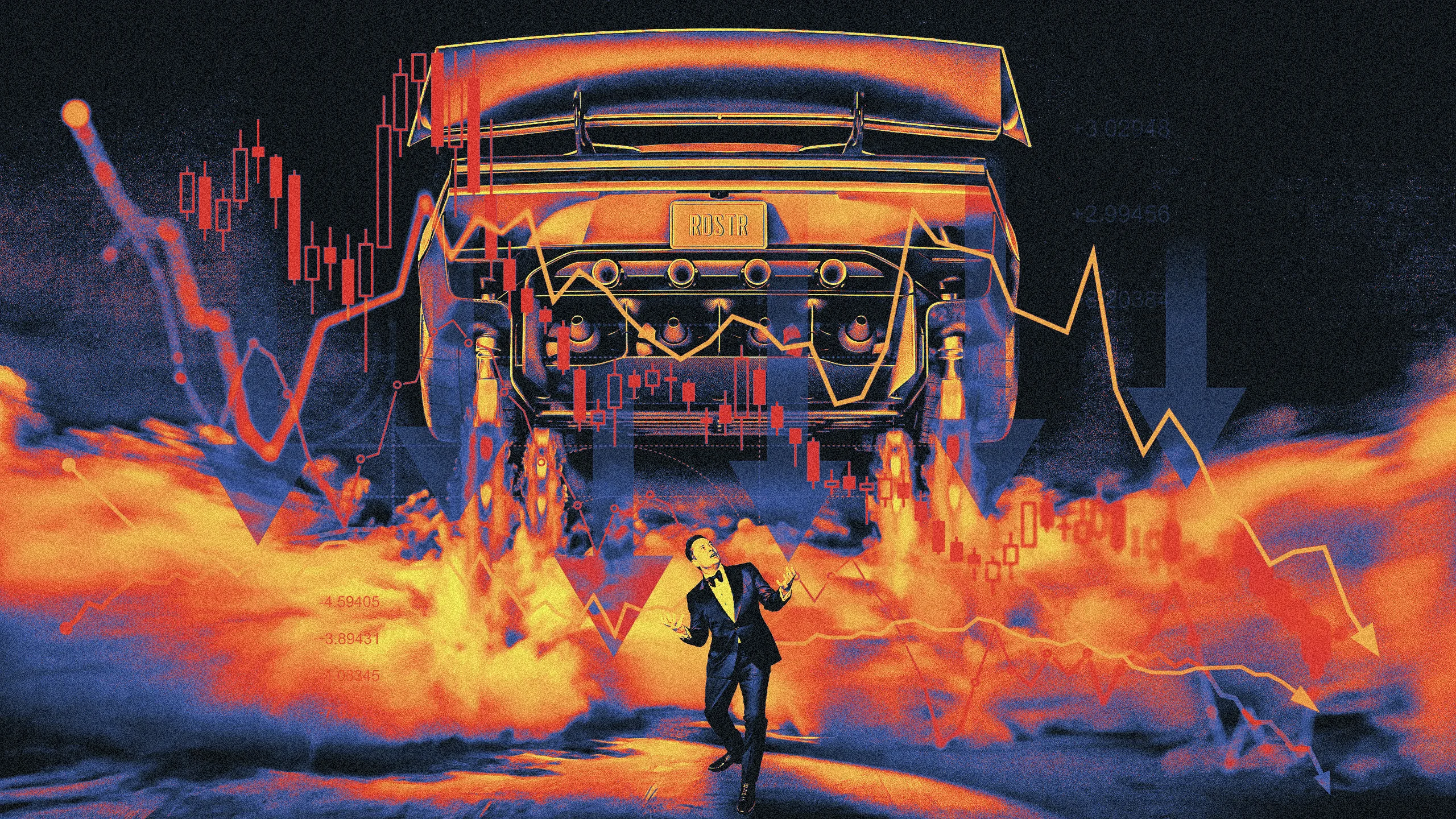
Last Thursday, Elon Musk made a Tesla Roadster flip and hover, thanks to cold-gas thrusters built by SpaceX. Five days later, on SpaceX’s third-quarter earnings call, he announced that the boards of Tesla and SpaceX are forming special committees to study the possibility of merging the two companies. If you think the timing is a coincidence, I have a Mars condo to sell you.
When I wrote about the Roadster last week, it felt obvious to me that the show was a marketing operation designed to convince shareholders to approve a merger between Musk’s companies. Its job was to make the synergies between his two companies look real. At unveiling, Musk called the Roadster “the culmination of incredible work by Tesla and SpaceX engineers working closely together.”
But that’s not synergy. That’s a stunt-y collaboration for a fantasy car that benefits neither Tesla nor SpaceX.
Ferdinand Dudenhöffer, director of the Center Automotive Research institute in Bochum, Germany, can’t imagine SpaceX’s cold-gas thrusters ever going into production cars. “It’s a bit like the flying cars that showed up in the comics of the 1950s,” he tells me via email. Back then, they were supposed to hit the market around 2000. “They remained utopias.”
To Dudenhöffer, the flying Roadster is a tech story meant to lift Tesla’s weak share price, and the synergy is “a modern marketing fairy tale.”
If the deal happens, the company will see itself diluted in a sci-fi melange of rockets, cellphones, and AI servers . Tesla’s stock was up about 3% in early Wednesday trading, while SpaceX got a 9% bump.
Source link