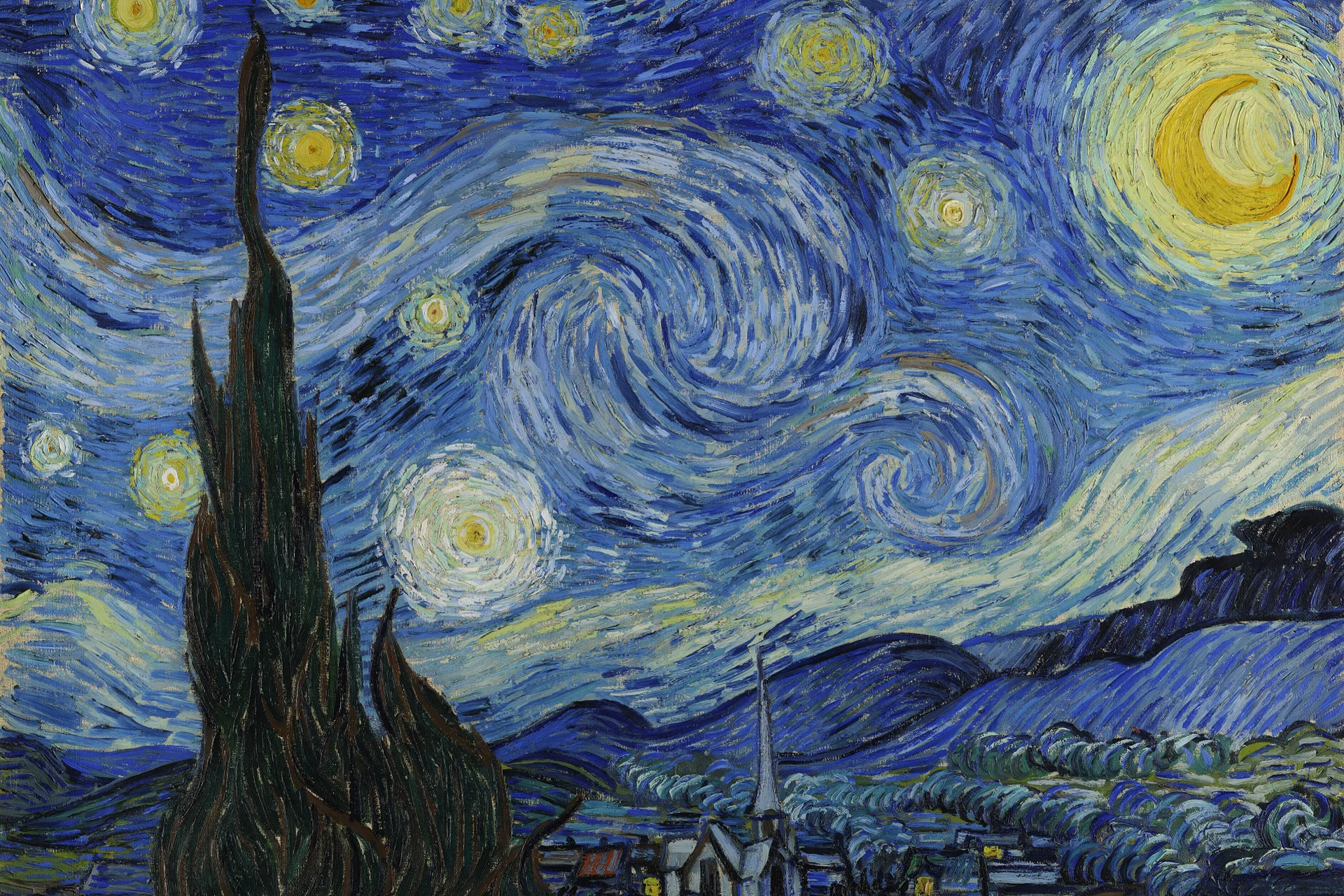
For a surprisingly long time, scientists have debated whether Vincent van Gogh’s The Starry Night was his fantasy, a symbolic representation, or an actual astronomical observation. Also surprisingly, many astronomers favored the latter, specifically that the painting depicted the night sky in June 1889.
But a study published today in Scientific Reports challenges that theory—and again, not in the direction you’d expect—and argues that The Starry Night likely represents the celestial arrangements of the sky before dawn on July 22, 1889. In what the team calls a project in “forensic astronomy,” the researchers studied astronomical simulations, historical weather records, and star positions, as well as van Gogh’s own letters from the time. Overall, all the evidence pointed to a late July date for the painting and simultaneously addressed concerns that brought doubt to the previous mid-June timeframe.
“This study shows that the sky depicted in The Starry Night corresponds observationally and geometrically with the actual dawn sky around July 22,” Elijah Jeong-hyun Kim, the study’s first author and the founder of SLLAB, a South Korean astronomy startup, told Gizmodo (self-translated from Korean). “So, we suggest that van Gogh ideated his work in June and completed it after July 22.”
The latest work isn’t the first time that astronomers and physicists made The Starry Night the subject of their scientific pursuits. To give a recent example, in 2024 Chinese physicists argued that the painting’s iconic swirls showed van Gogh had a deep, intuitive understanding of natural phenomena like turbulence.
Source link