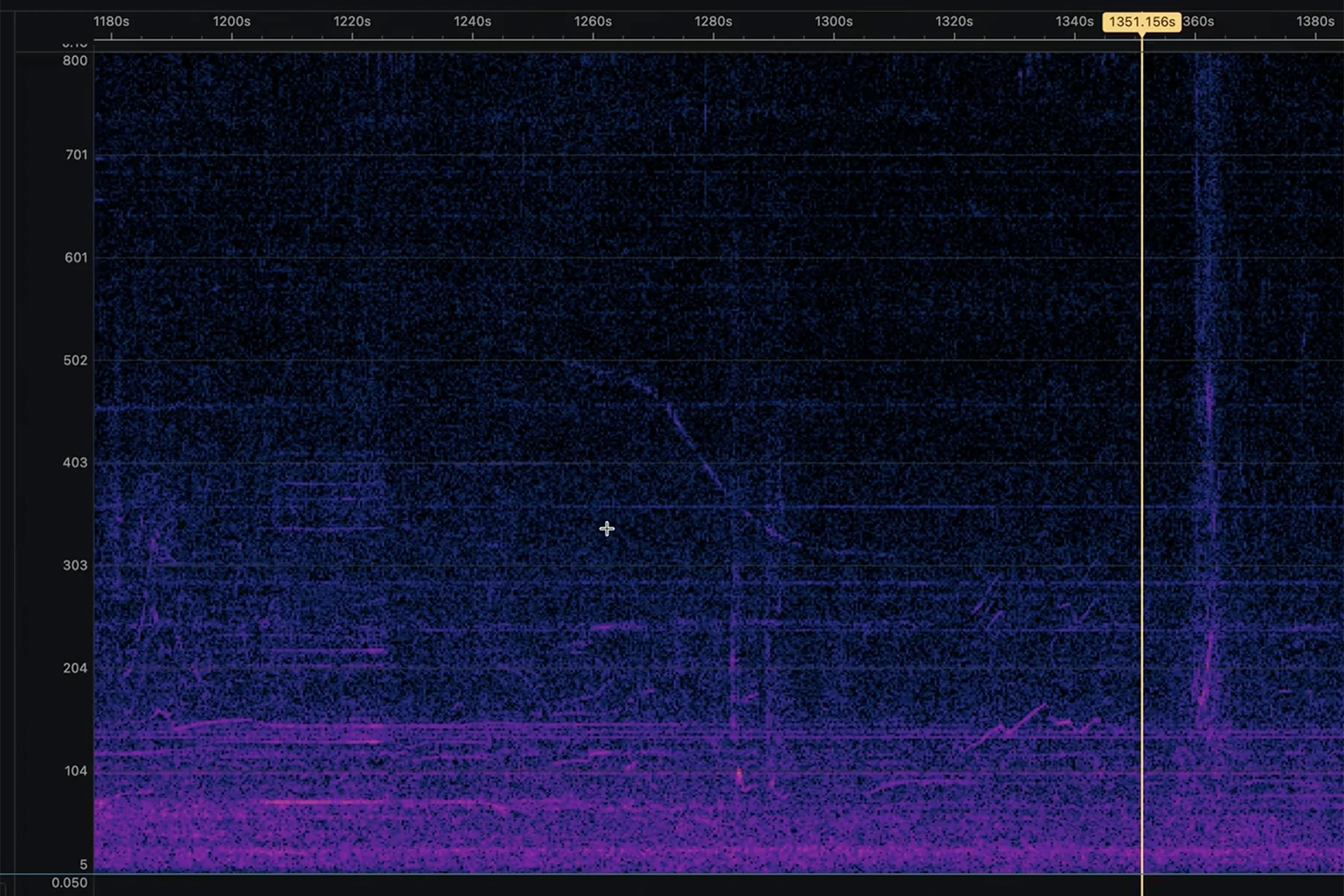
YouTuber Colsto has made a name for himself by finding novel ways to track down hidden locations: those of album cover shots, Primitive Technology, and, um, Andrew Tate. (Happily, we can all do the last one now.) In his latest video, though, Colsto has outdone himself. The video describes a technique that can reveal where an otherwise unidentifiable recording was made by analyzing its audio for the faint sounds of passing aircraft. The technique is both fascinating and frightening.
It works by looking at Doppler curves, which plot the way a plane’s sound changes as it passes overhead because of the Doppler effect. This is the same familiar Doppler effect that causes the frequency of a siren to rise as it approaches and then fall as it passes by and moves away. More generally, it’s the phenomenon whereby the frequency of a wave perceived by an observer changes when the observer and the source of the wave are moving in relation to one another. (It applies to all sorts of other waves, by the way, including electromagnetic ones, which we discussed recently in the context of the weird things that happen as you approach the speed of light.)
It’s sound that’s relevant here, though, and specifically the sound of aeroplanes. Early in his video, Colsto brings up a map of the flights that were in the air at the time the video he’s tracing was recorded. Much of this information is publicly available. Aircraft equipped with Automatic Dependent Surveillance–Broadcast (ADS-B) transmit data about their position, velocity, and altitude, which flight-tracking services collect and make available to the public.
Source link