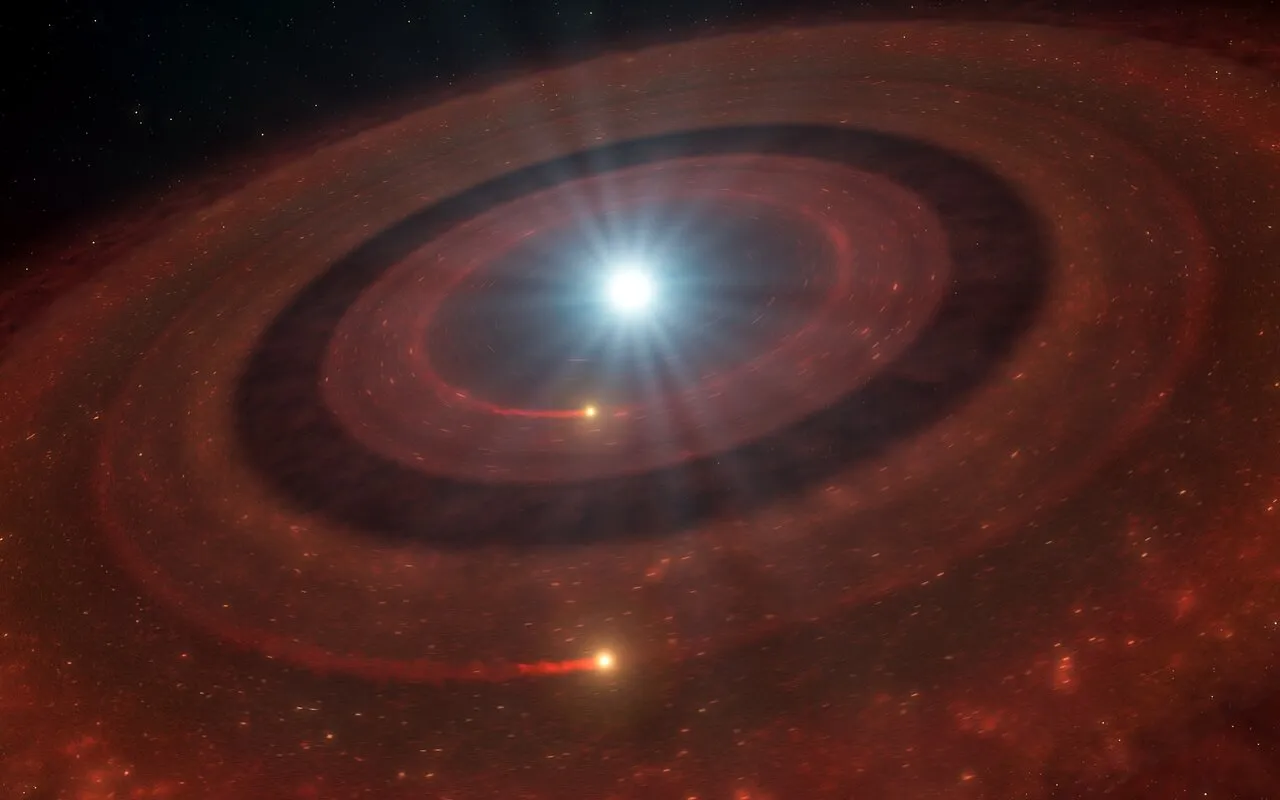
Astronomers at the European Southern Observatory (ESO) have discovered a debris disk around a white dwarf, consisting of the remnants of the solar system that once orbited it. For researchers, these structures could offer a clue as to what the end of our solar system will look like once the sun runs out of fuel.
The white dwarf J1328−1450 is located about 1,600 light-years from Earth. Astronomers were already aware of it thanks to star-mapping catalogs, but new observations taken with ESO’s Very Large Telescope (yes, that’s its real name) revealed that it is surrounded by a disk of debris with an unusual structure: Two distinct rings of gas separated by a gap.
According to the observatory, this disk of material is likely the remnant of the planetary system that once orbited J1328−1450. As it passed through a red giant phase and subsequently became a white dwarf, the star may have destroyed some of its planets and left other rocky bodies exposed to an extreme environment. Some of the released material ended up forming a disk of gas and dust around the dead star.
The process that shaped this system could repeat itself in our own. In about 5 billion years, the sun will exhaust its fuel and expand into a red giant. During this phase, it could engulf nearby bodies , like the closest planets. It will then shed its outer layers, leaving behind a white dwarf. Any rocky bodies that survive this transformation could break apart and form a debris disk around the dead star, like the one astronomers are now observing in J1328−1450.
Source link