Silicon can store far more charge than graphite, but keeping silicon-rich batteries working over repeated charging cycles remains a hurdle to industrial use.
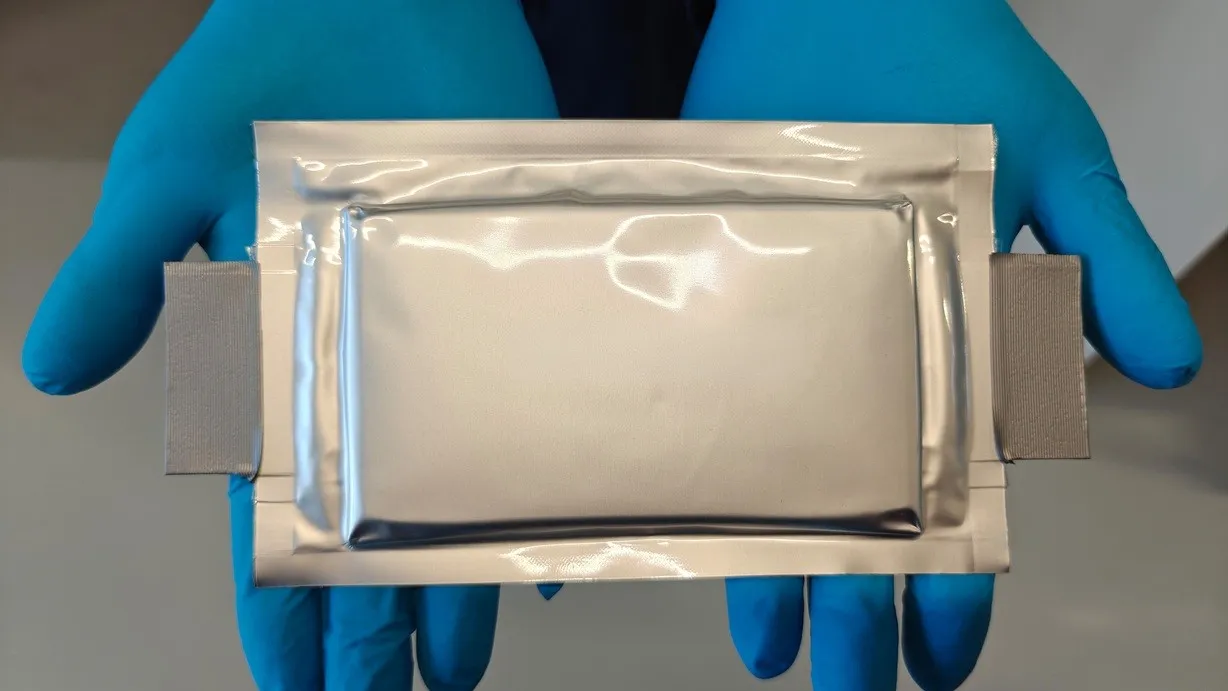
Researchers at Germany’s Fraunhofer Institute for Solar Energy Systems ISE have now tested pouch cells that retained over 83 percent of their original capacity after more than 1,000 full cycles.
Announced on October 20, the StrOboBatt project results came from in-house-manufactured, 25-Ah cells with silicon-rich anodes.
The research cells achieved an energy density of 280 Wh/kg, advancing high-energy batteries for electric mobility, aerospace, and stationary storage.
The results also highlighted an operating requirement: mechanical pressure significantly affected the cells’ ability to maintain performance.
“Cycle life is one of the key hurdles to the widespread industrial use of silicon-rich anodes. More than 1,000 cycles with a capacity retention of at least 80 percent is considered an important performance target here,” said Dr. Lukas Dold, team leader for battery materials technology and scaling at Fraunhofer ISE.
The team manufactured multilayer full cells containing 40 layers, using commercially available electrode foils. These paired a silicon-carbon/graphite anode with a nickel-rich nickel-manganese-cobalt oxide cathode.
Silicon has a theoretical specific capacity ten times that of graphite, the material currently used in battery anodes. In the test cells, a silicon-carbon composite accounted for 51 percent of the anode active material.
The anodes achieved a specific capacity above 1,000 mAh/g and an areal capacity exceeding 5 mAh/cm².
Fraunhofer ISE expects an industrially optimized pouch cell format to reach approximately 330 Wh/kg.
That figure is a projection; the demonstrated energy density was 280 Wh/kg in the institute’s non-optimized PrecISE research format.
Source link