
Forward-looking: Micron has outlined its memory and storage roadmap for the next few years, revealing significant upgrades across its next-generation products. The plans span DDR6, LPDDR6, HBM, and NAND, as the AI infrastructure spending boom continues to push hardware costs higher.
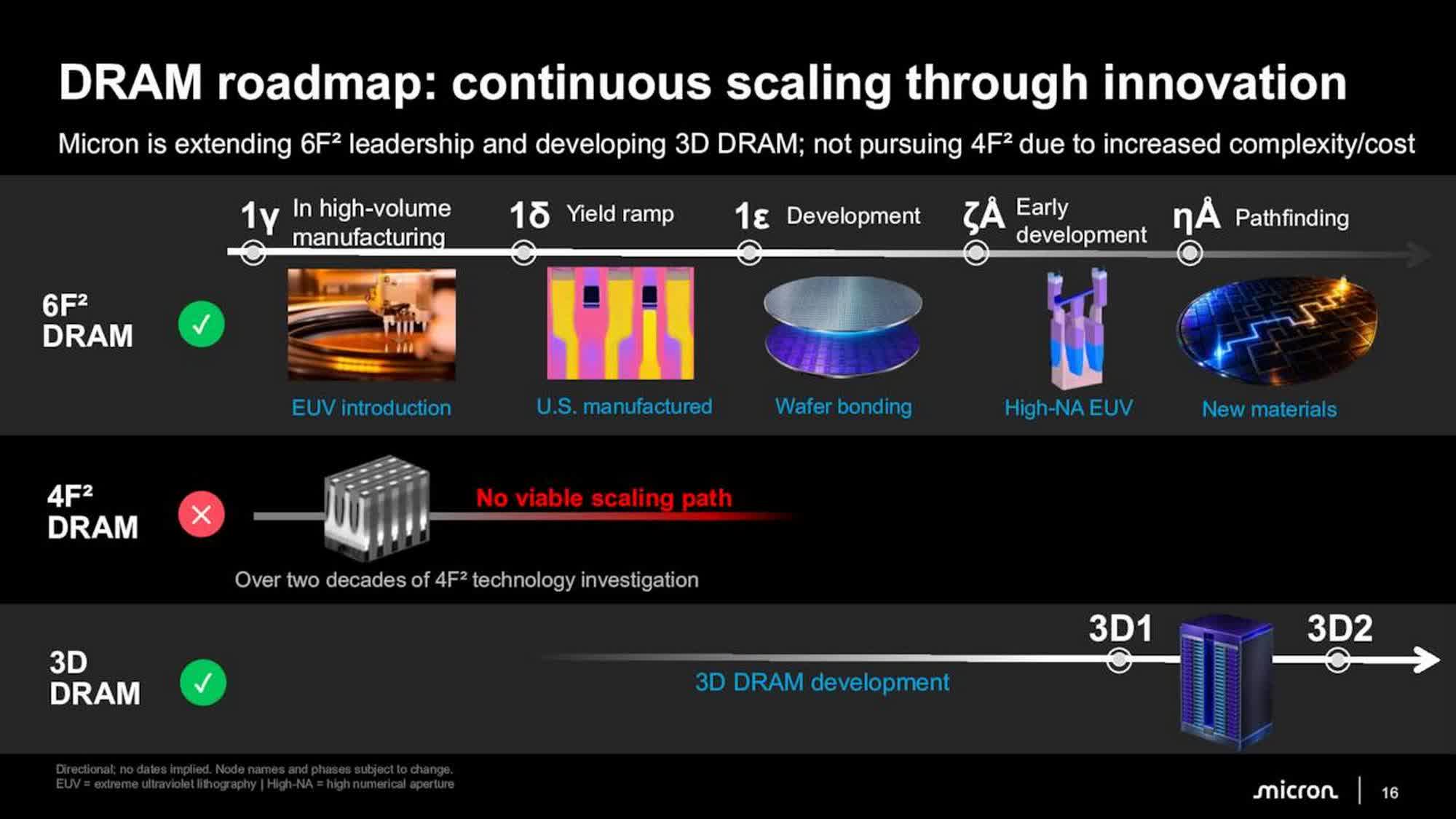
Micron has detailed its 1δ (1-Delta) node as the follow-up to 1γ (1-Gamma). The new node, which features angstrom-level process control and HKMG CMOS structure, will reportedly deliver roughly 25% higher bit density than its predecessor when manufacturing advanced DRAM products.
Micron added that 1-Delta will support next-generation memory standards such as DDR6 and LPDDR6, with the former offering more than twice the bandwidth of DDR5. The company, however, is positioning DDR6 as high-reliability server memory for AI data centers rather than a direct successor to DDR5 for client PCs.
Micron expects 1-Delta to enter volume production in H2 2027, but there's no official launch date for DDR6 yet.
Micron earlier demonstrated a 512GB DDR5 RDIMM running at 9,200MT/s in September 2026. The company now says its next-generation technology will deliver 1TB RDIMMs for high-density AI workloads, and claims it will be the industry's highest-capacity RDIMM when it enters production.
As for LPDDR6, Micron claims it will deliver 35% better power efficiency than LPDDR5, with even bigger gains at some densities. Scott DeBoer, the company's president and chief technology and products officer, said Micron is working with a range of partners, including Meta, to deploy LPDDR6 memory in AI data centers.
Micron also revealed that its future memory products will use 6F² (6-Feature-Square) DRAM rather than 4F², citing cost, complexity, and capacitor pitch limits that significantly reduce the latter's scalability.
Source link