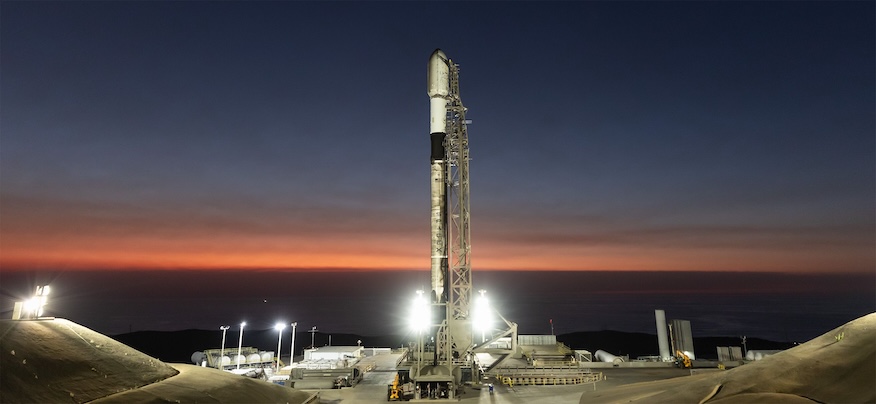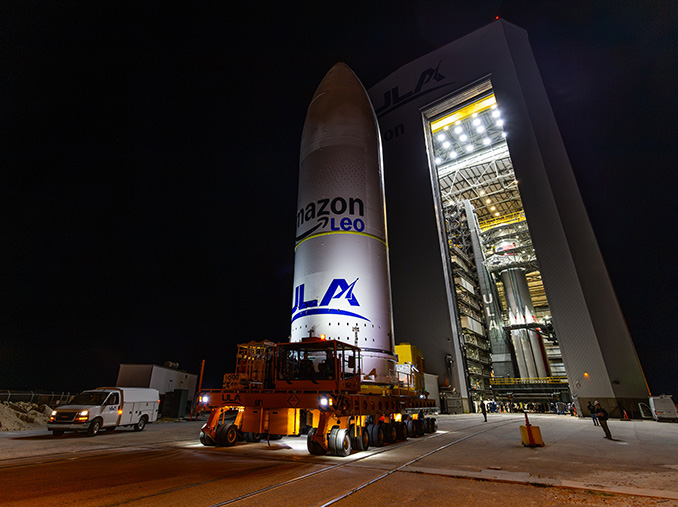
United Launch Alliance said its fledgling Vulcan rocket would return to flight Friday, November 13, after a nine-month grounding due problems with its solid rocket boosters.
This mission, carrying 40 satellites for Amazon’s Leo internet service, will be the fifth flight of Vulcan since it debuted in 2024 and will be the first time it has been fitted with six strap-on solid rocket boosters.
It was nozzle failures on the Northrop Grumman-built solid rockets that put Vulcan flights on hold earlier this year. The rocket’s second flight was marred by the disintegration of a nozzle on one of the two 63XL Graphite Epoxy Motors. United Launch Alliance thought it had put the problem behind it, but a similar nozzle failure afflicted one of the four boosters less than 30 seconds into Vulcan’s fourth flight in February 2026 on the USSF-87 mission. In both cases the methane-fueled first stage and hydrogen-fueled upper stage were able to compensate for the resulting reduced and asymmetric thrust and achieved the intended orbits.
An industry-government team comprising of ULA, Northrop Grumman, and the U.S. Space Force was convened to investigate the most recent incident. ULA didn’t provide any specific details about the findings of the investigation but said in a statement: “The integrated team has made great strides in improving our understanding of the solid rocket booster (SRB) anomaly that occurred on the previous Vulcan flight and have identified several potential contributors which have been mitigated through design and process improvements to the nozzle,”
“This upcoming launch will utilize the improved nozzle design, and additional testing and analysis will continue in parallel with the mission,” the company added.
Source link