Much of Mars’ surface preserves a geological history stretching back billions of years, yet most Martian meteorites found on Earth come from considerably younger periods. This leaves scientists with few physical samples from the planet’s earliest history.
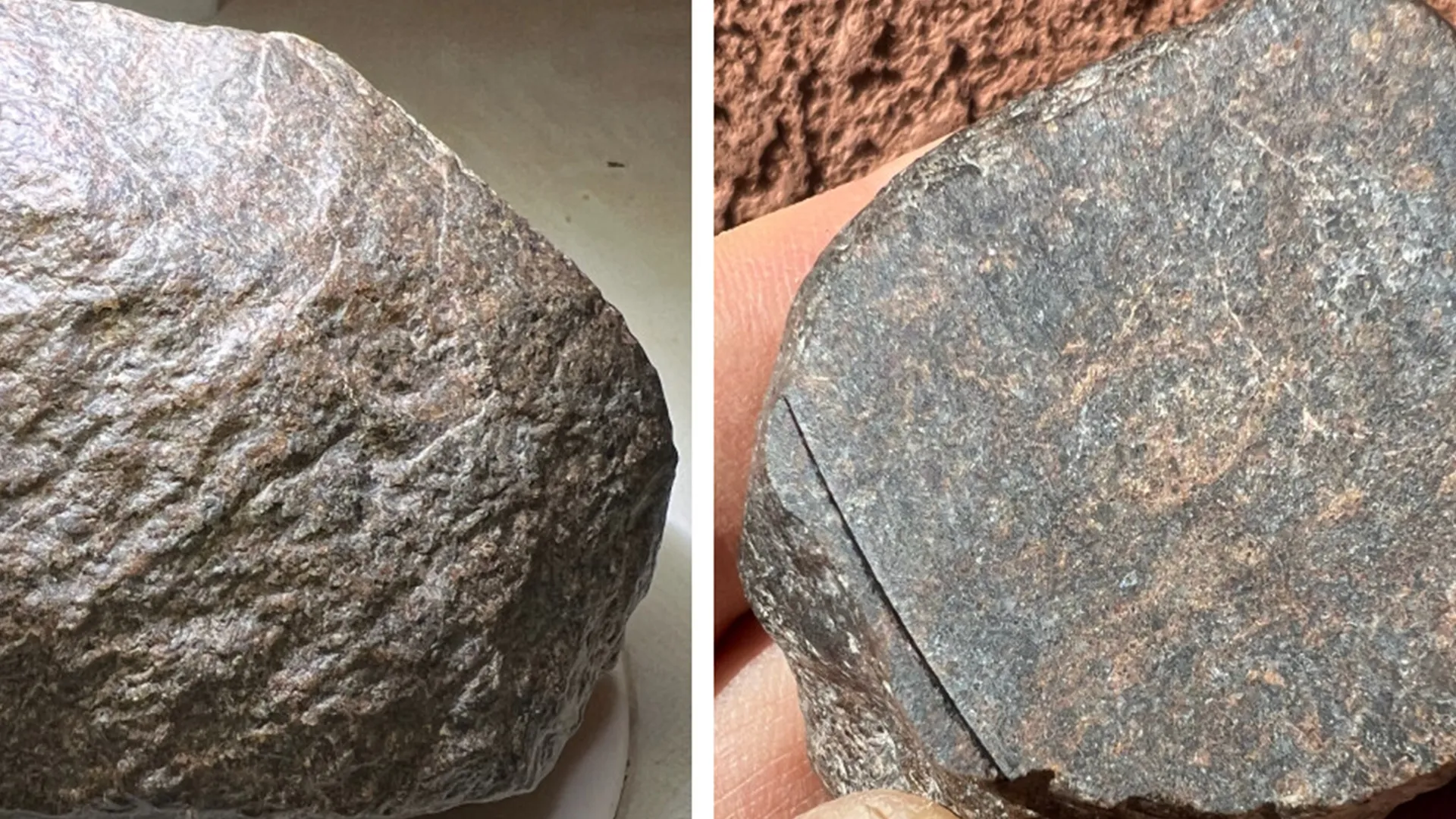
Now, a rose-colored rock recovered from the Sahara Desert could help fill that gap. Named Teghaza 001, the 800-gram meteorite preserves a piece of Martian crust that formed at least 4.1 billion years ago, carrying clues to how the planet’s interior, surface, and water systems evolved.
This discovery, described in detail in a recent study, is particularly important because the meteorite does not simply offer another glimpse of ancient Mars. Its unusual mineral composition points to a previously unsampled type of crust, while signs of water-related alteration suggest that liquid interacted with Martian rocks during the planet’s earliest geological history.
“This is really our first piece of Martian crust from a part of Mars we’ve never had a sample of before. It records interactions of water and rock and maybe even an imprint of the Martian atmosphere as it was losing water,” Lee Saper, one of the study authors and a scientist at NASA, said.
Teghaza 001 was discovered in Mali’s Sahara Desert in 2022 and initially identified as Martian through its oxygen isotopes. These isotopes act as geochemical fingerprints, allowing researchers to distinguish material originating from Mars from rocks belonging to Earth or other planetary bodies.
However, its real significance emerged when scientists examined its internal structure and mineral composition.
Source link