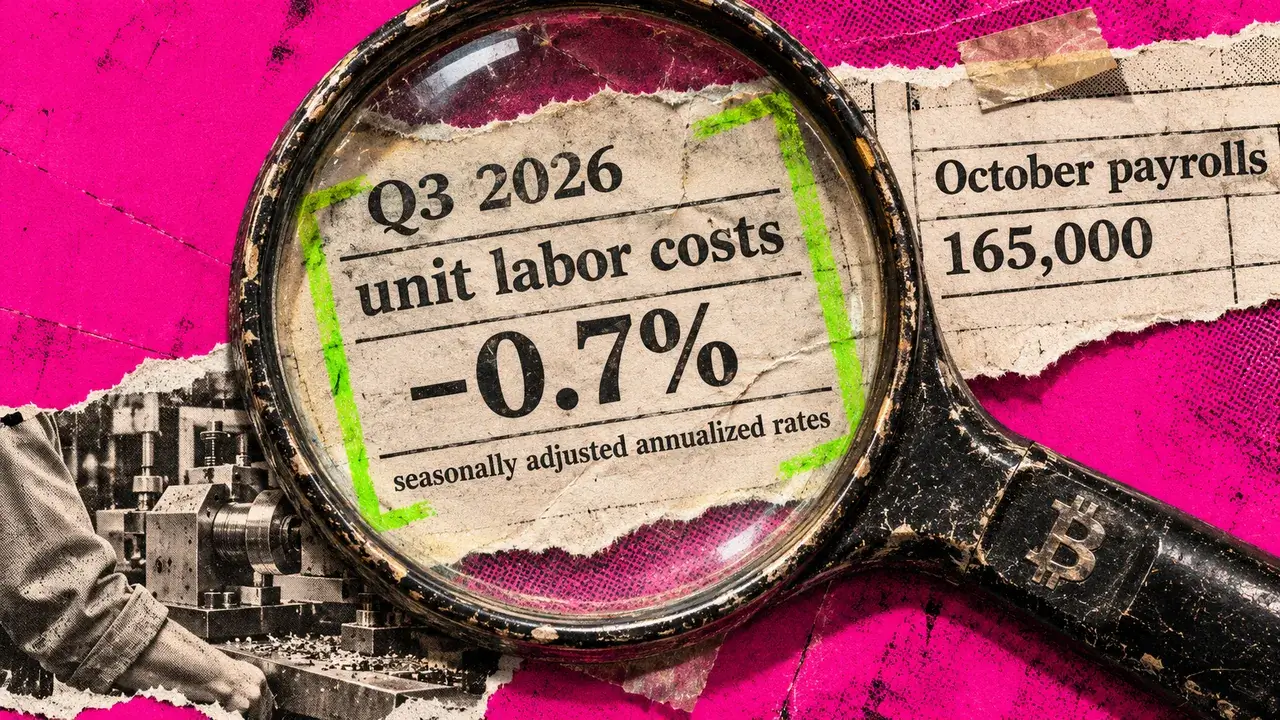
Preliminary Q3 productivity outpaced hourly compensation, offering a cost counterpoint while inflation keeps the Fed cautious.
US nonfarm businesses produced more per hour in the third quarter, allowing labor costs per unit of output to fall even as hourly compensation rose. For Bitcoin, that offers a potential offset to jobs-driven rate fears: if lower cost pressure helps cool inflation and expected interest rates, financing could become less expensive.
The Bureau of Labor Statistics' preliminary November 5 release showed nonfarm business productivity rising 3.6% as output increased 3.7% and hours worked rose 0.1%. Hourly compensation increased 2.9%, while unit labor costs fell 0.7%. All those quarterly changes are seasonally adjusted annualized rates.
Unit labor costs track compensation relative to output. BLS divides hourly compensation by productivity: when each hour produces more, businesses can pay more per hour without incurring higher labor costs for each unit they produce.
Q3 productivity grew faster than hourly compensation. The quarterly cost decline coexisted with a positive year-over-year cost reading.
Productivity can absorb higher pay; quarterly labor-cost relief does not settle the inflation outlook.
Preliminary Q3 nonfarm business estimates, published November 5, 2026. Quarterly figures are seasonally adjusted annualized rates; the 2.4% figure is year over year. This is not consumer-price inflation, October productivity or a Bitcoin response.
Plot reported Q3 annualized changes on one linear scale: 80 SVG units per percentage point on desktop and 44 on mobile. The 2.4% four-quarter change is shown separately without a comparable bar. No growth-rate subtraction or new calculation.
Source link