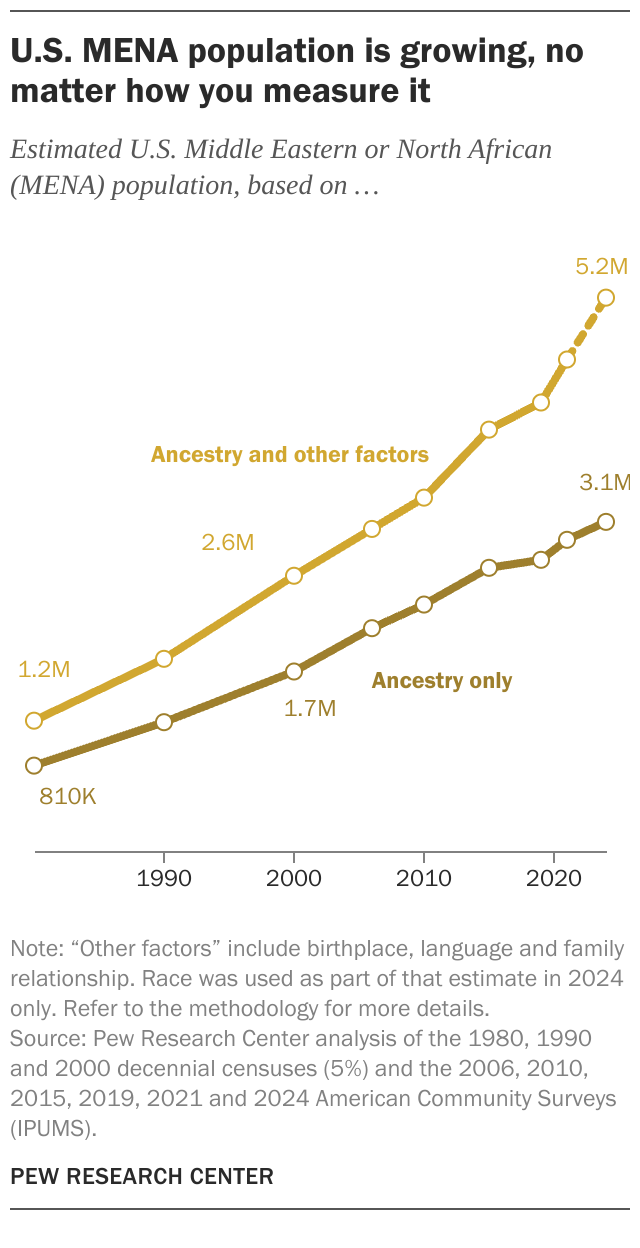
People of Middle Eastern or North African origin are a growing segment of the U.S. population. There are several ways we can estimate the size of this population today, using self-reported ancestry, race and other factors. Depending on which of these characteristics we consider, our estimates range from 3.1 to 5.2 million people, according to a Pew Research Center analysis of 2024 data.
When government surveys ask about race, there is no “Middle Eastern or North African” (MENA) category that people can select. Instead, the U.S. Census Bureau classifies people who give a MENA origin – like Lebanese, Iranian or Egyptian – as White, even though that may not reflect their identity or lived experience.
In 2024, the government updated its standards for race and ethnicity data. Among other changes, it added a MENA race category in all federal statistics, to be implemented by March 2029. The Census Bureau said the update would produce more accurate race and ethnicity data, which can affect things like the drawing of congressional districts and distribution of government resources. MENA community groups had long advocated for this change to give them higher visibility.
But exactly when – and whether – these changes will take place is unknown. The Trump administration has twice delayed rolling out these revisions, and it recently proposed removing all questions about race and ethnicity from the 2030 census.
S. MENA population and the ways we can estimate the size of the population with available public data.
Source link