This article has been reviewed according to Science X's editorial process and policies. Editors have highlighted the following attributes while ensuring the content's credibility:
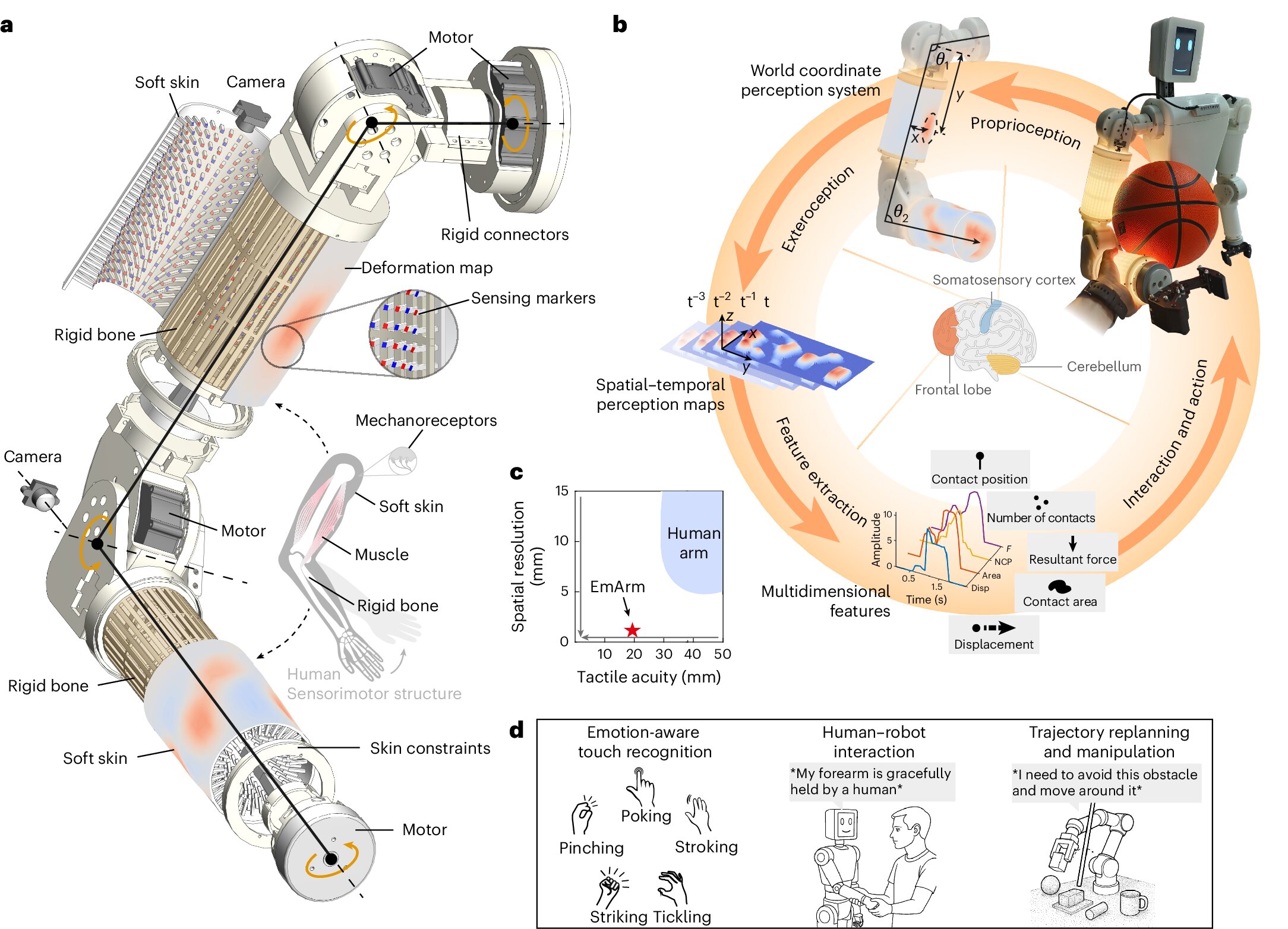
A research team at The Hong Kong University of Science and Technology (HKUST) has developed an Embodied Sensorimotor Robotic Arm (EmArm) capable of whole-arm tactile sensing and adaptive manipulation. By embedding a soft optical tactile skin directly into a robotic skeleton and integrating it with a real-time decision-making algorithm, EmArm can perceive and analyze contact information across its upper and lower arms, enabling human-like tactile perception and adaptive object manipulation. The system can also distinguish between different touch interactions, such as tickling and patting, respond in real time and avoid obstacles through tactile feedback, opening new possibilities for the development of embodied intelligent robots.
The study was led by Shen Yajing, a professor in the Department of Electronic and Computer Engineering (ECE) and associate director of Cheng Kar-Shun Robotics Institute, and his team at the Mevita Robotics Lab. Other authors of the paper include postdoctoral researchers Dr. Tang Yifeng (first author), Dr. Li Gen and Dr. Ren Hao; doctoral students Yin Tianci, Ling Zhengrong, Zhao Haoxiang and Zhang Ruijia; and lab graduates Zhang Tieshan (Shenzhen University) and Yang Liu (Nankai University, Tianjin). The findings are published in Nature Sensors under the title "Embodied sensorimotor integration for whole-arm tactile sensing and adaptive robotic manipulation."
Inspired by the human body's "bone-muscle-skin" structure, the team embedded a large-area soft optical tactile skin inside EmArm's rigid mechanical skeleton, integrating high-load operation with soft tactile sensing.
Source link