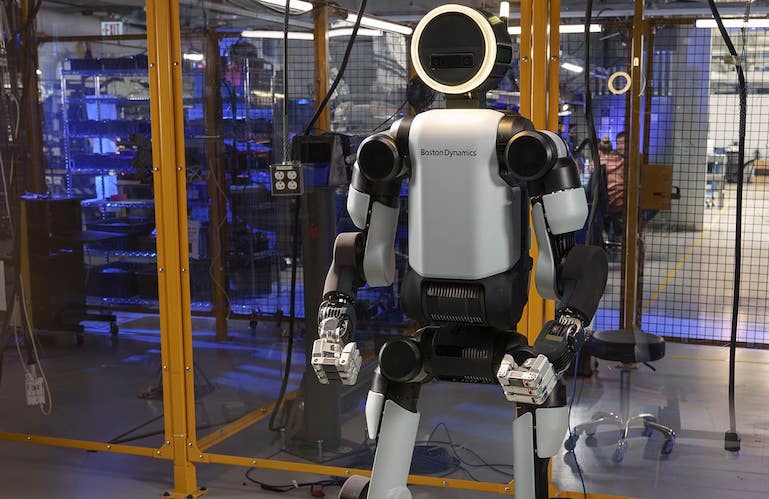
Boston Dynamics’ Atlas humanoid, shown here, is an example of a robot ready for AI.
For decades, engineers have been trying to create robots that look and act like humans. Now, rapid advances in artificial intelligence are bringing humanoid robots out of the lab and onto the factory floor. As fears grow that AI will displace workers, a global race is underway to develop humanoid robots capable of performing human work.
Competitors include Tesla, startups backed by Amazon and NVIDIA, and state-owned Chinese companies. Waltham, Mass.-based Boston Dynamics, valued at over $1 billion, is among the humanoid leaders with its Atlas robot. South Korean automaker Hyundai owns an 88% stake in the company.
Hyundai‘s massive auto plant is arguably the most advanced in the world. More than 1,000 robots work alongside nearly 1,500 humans, lifting, stamping, and welding parts in robotic unison. Atlas, at 175 cm (68.8 in.) tall and 90 kg (198.4 lb.) in weight, has left the lab and is doing real work.
Atlas’s development is led by Zach Jackowski. He holds two degrees in mechanical engineering from MIT, and his mission is to transform the robot into a productive worker on the factory floor. Atlas confidently helps sort roof racks for the assembly line without human intervention. It operates autonomously; many roboticists would have considered this insane five or six years ago.
In 2021, Atlas was a bulky, hydraulic robot that could only run and jump. Back then, Atlas relied on algorithms written by engineers.
Source link