As robotics systems grow more capable — faster, more precise, and increasingly reliant on AI-driven vision and control — the humble interconnect is being asked to do more than ever. Signal integrity, mechanical durability, and board real estate are no longer secondary considerations in robotics design; they’re often the limiting factor. 3M has built out a portfolio of connectors, cables, and cable assemblies aimed squarely at these pressure points, and the company’s interconnect strategy for robotics offers a useful lens into where the industry’s hardware challenges are heading.
Robotic joints, arms, and end effectors don’t sit still — they twist, bend, and cycle continuously, often for years without a maintenance window. Cabling that fatigues or fails under that mechanical stress is one of the more common causes of unplanned downtime in automated systems.
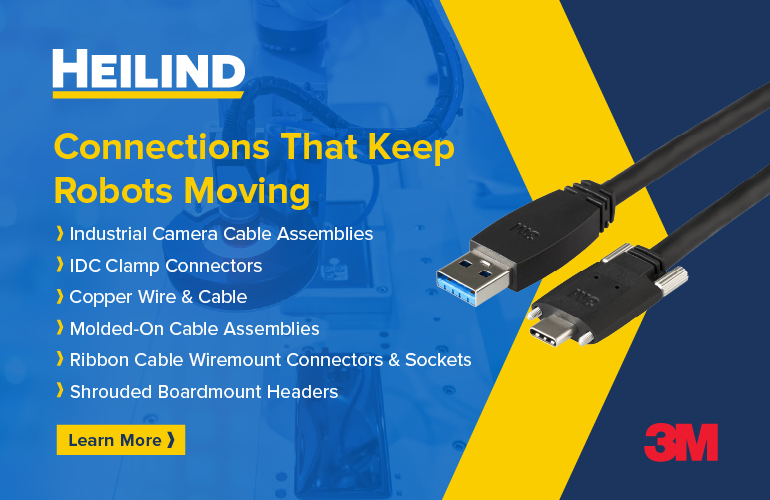
3M’s answer is a family of high-flex cable assemblies built specifically for motion-intensive applications. CoaXPress-compatible assemblies are flex-cycle tested to 45 million cycles, while USB3 Vision-compatible assemblies push that rating to 100 million cycles. On the flat-ribbon side — used widely for I/O and data runs in robotic subsystems — 3M offers a range spanning roughly 1 million to 100 million flex cycles, giving engineers a way to match cable durability to the actual duty cycle of a given axis or joint, rather than over- or under-engineering the harness.
For machine vision applications specifically, where camera cables are constantly routed through moving linkages, this kind of validated flex-life data lets designers make a real engineering trade-off instead of a guess.
Source link