This article has been reviewed according to Science X's editorial process and policies. Editors have highlighted the following attributes while ensuring the content's credibility:
A new AI model developed by researchers at the Technical University of Munich (TUM) teaches robots to recognize their own limitations. When they encounter an unfamiliar situation they cannot handle, for example, they simply stop and wait for someone to help them. This enables robots to continuously learn new skills without forgetting what they already know or putting people at risk.
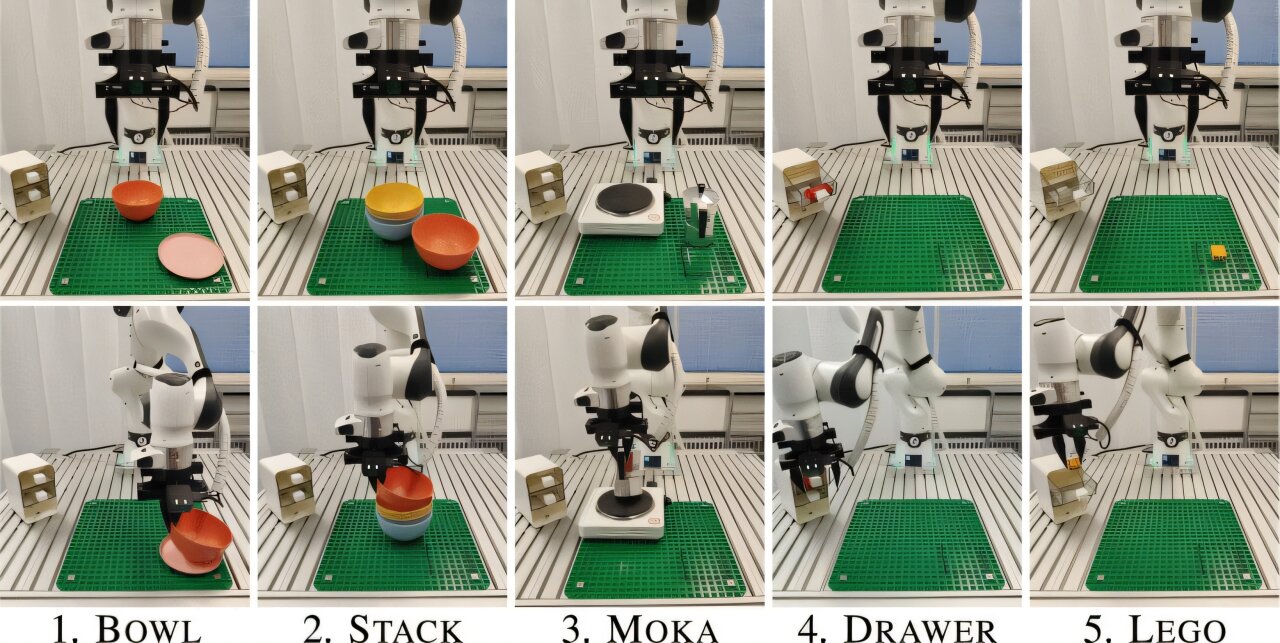
For an AI-controlled robot to navigate the real world, it not only needs to keep learning but must also realistically assess its own capabilities. A new AI model developed by a research team led by Ralf Römer and Professor Angela Schoellig now combines both abilities in a single system. The researchers from the TUM Chair of Safety, Performance and Reliability use what is known as a vision-language-action model (VLA).
A VLA works much like ChatGPT, Claude or Gemini, but for the "real" world. It translates verbal instructions into robot actions, using current images from the robot's cameras to correctly assess the situation. While conventional language models can draw on a virtually unlimited supply of text and images from the internet, there is no comparable wealth of data on robot movements.
New data can be generated by demonstrating human movements to robots or by simulating them on a computer, but these methods cannot cover every situation a robot might encounter in the real world.
To enable the AI model to control movement in real time, the researchers build on comparatively small language models, such as Google's open-source PaliGemma model.
Source link