This article has been reviewed according to Science X's editorial process and policies. Editors have highlighted the following attributes while ensuring the content's credibility:
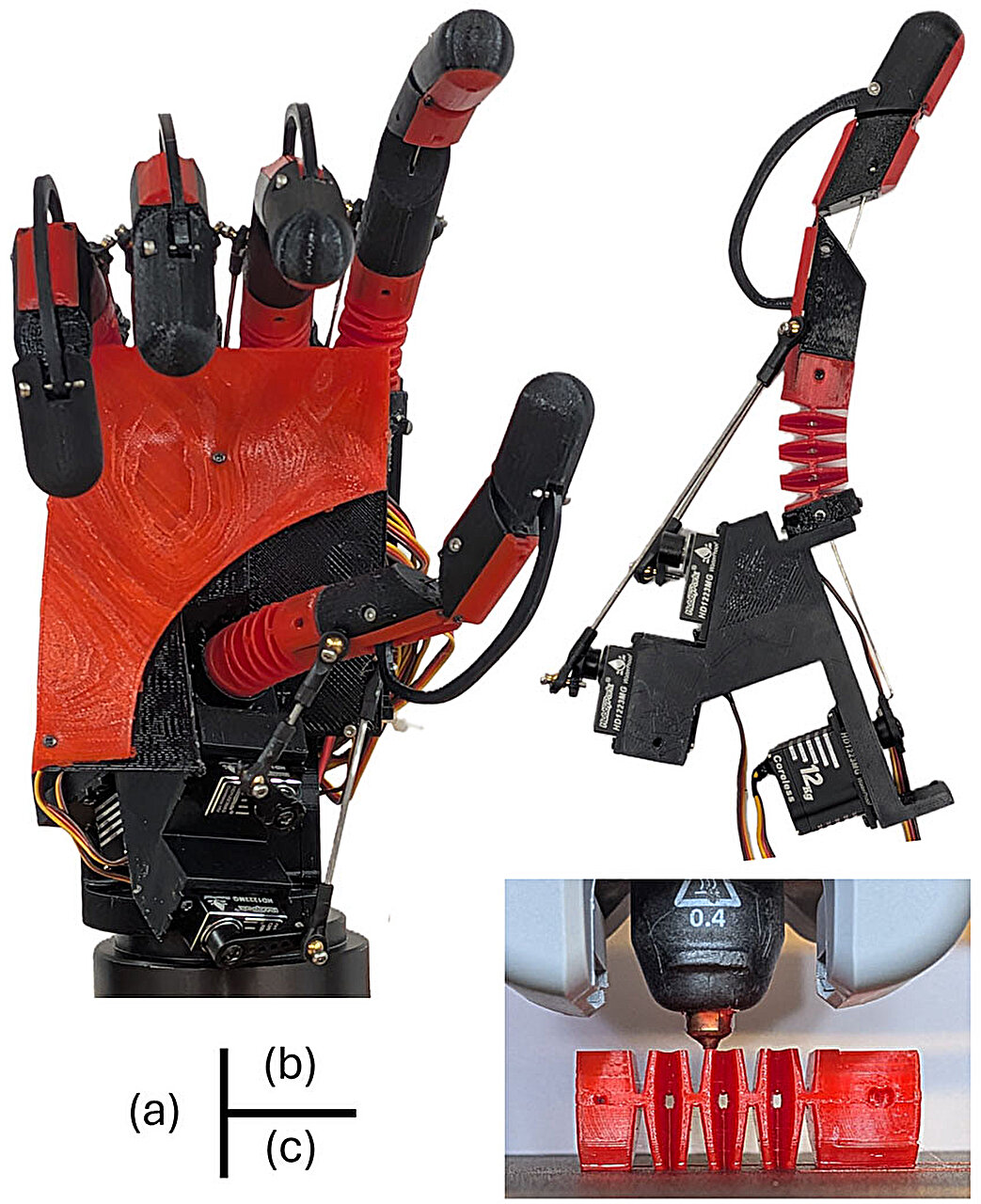
Pneumatic artificial muscles (PAMs) are lightweight and flexible, with a high power-to-weight ratio. These properties have made antagonistic PAM-driven joints widely used in soft robotic systems. However, precise and reliable control requires accurate estimates of joint states.
PAM-driven systems exhibit strong nonlinearities and hysteresis, making accurate state estimation challenging. Conventional model-based estimation methods, such as the unscented Kalman filter (UKF), can effectively handle nonlinear systems, but unmodeled dynamics and model inaccuracies often limit their estimation accuracy.
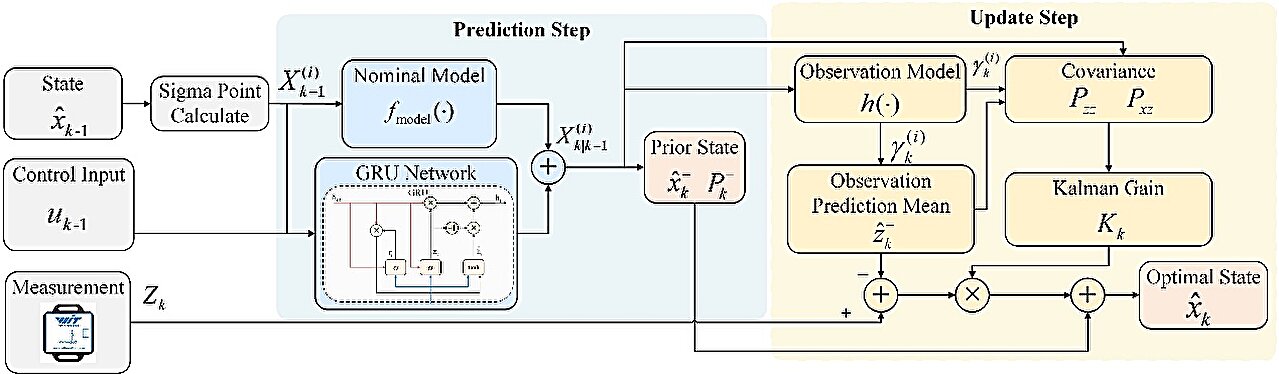
In a study published in IEEE Robotics and Automation Letters on Oct. 21, Dr. Li Jun's group from the Fujian Institute of Research on the Structure of Matter of the Chinese Academy of Sciences developed a hybrid state estimation method that integrates a gated recurrent unit (GRU) neural network with a UKF. The proposed GRU-UKF framework compensates for unmodeled nonlinear dynamics using historical system information.
The researchers first established kinematic and dynamic models of an antagonistic PAM-driven joint and used them to build a UKF-based state-estimation framework. However, the simplified model could not fully capture the complex hysteresis and nonlinear behavior of pneumatic actuators.
To address this limitation, the researchers introduced a GRU-based dynamic residual compensation model. The neural network learns the discrepancies between model-predicted states and actual system states using historical sequences. By capturing temporal dependencies, the GRU predicts history-dependent dynamic residuals that the conventional physical model cannot adequately represent.
Source link