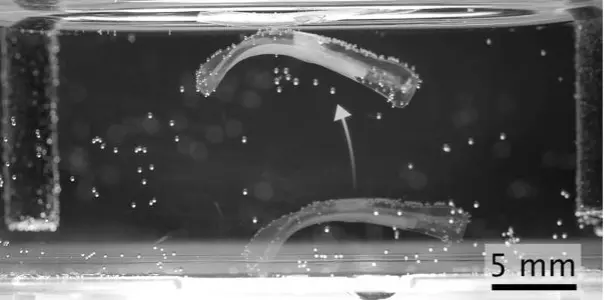
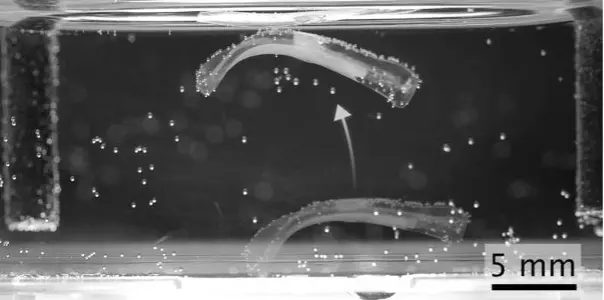
 The biohybrid robot pushes off from the ground as soon as it is stimulated by an electrical impulse. Credit: Nature Communications (2026).
In our monthly series, we showcase a selection of robotics stories from society, business, research and culture, as we track the field’s ongoing journey from specialized industrial machines to an increasingly visible social phenomenon.
A Toyohashi University of Technology team tested whether a robot’s approach direction changes how fast it seems to move. Across five experiments using a real mobile robot and virtual reality, 92% of participants showed the same bias: at the same physical speed, a robot approaching from behind seemed faster than one approaching from the front.
In the first experiment, participants learned two reference speeds—0.5 and 1.0 metres per second—then judged a robot approaching at speeds between those values. Follow-up experiments suggested the effect wasn’t explained by the robot’s appearance or motor noise. The researchers link it instead to visual factors involved in turning to look at something coming from behind.
The researchers say further work is needed to see how the bias affects comfort, perceived safety, and people’s actual avoidance behaviour.
Engineers at Delft University of Technology have developed an AI system that enables a racing drone to navigate demanding courses at extreme speed using only a single camera, while outperforming human drone champions in the process. The team’s MonoRace autonomous drone system generalizes to a competition environment without any external motion tracking system, using only a monocular rolling-shutter camera and an inertial measurement unit.
Source link