This article has been reviewed according to Science X's editorial process and policies. Editors have highlighted the following attributes while ensuring the content's credibility:
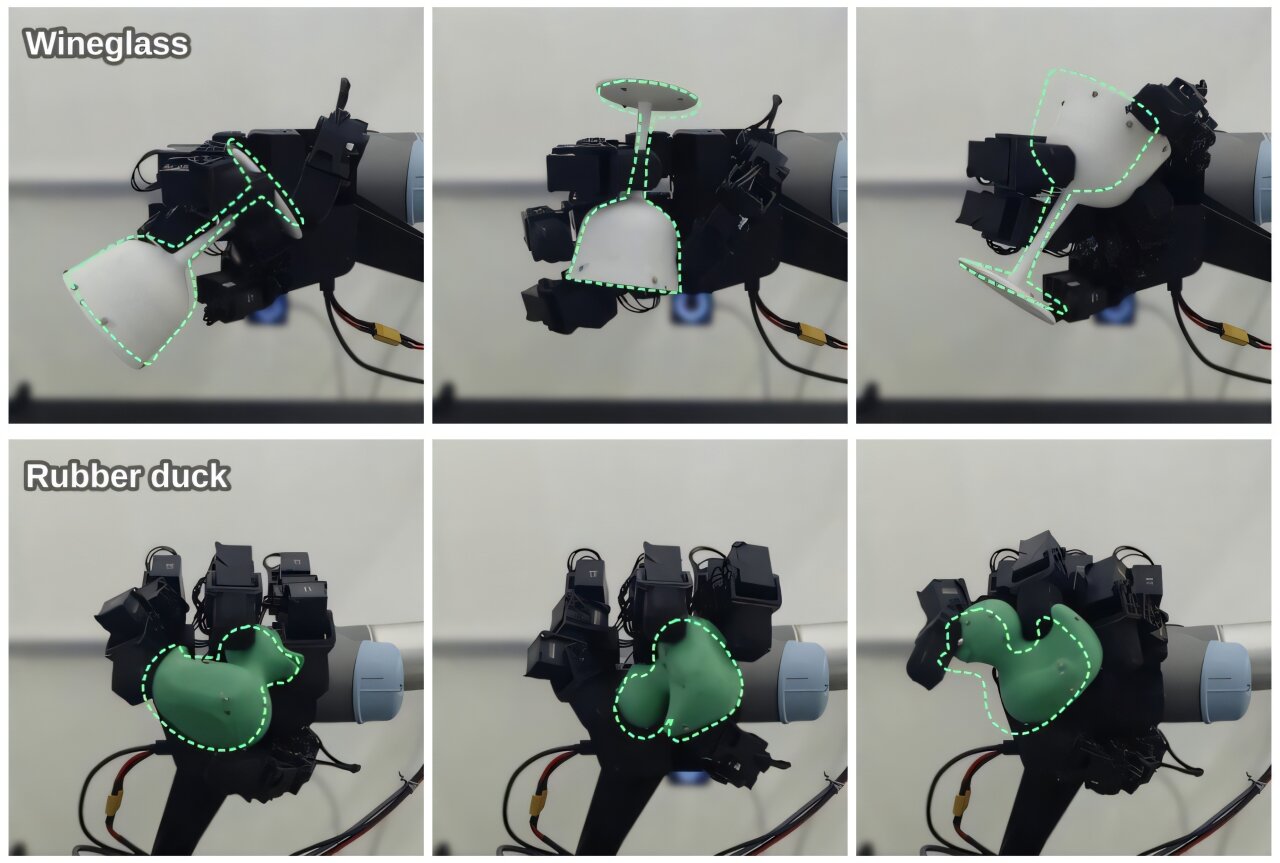
Manipulating an object with one hand is a balancing act. Fingers must release and renew their grip while keeping the object from slipping away, even with the palm facing downward.
Researchers have now trained a robot hand to perform these maneuvers and added a separate software safeguard to reduce object drops. In tests guided by external motion-tracking cameras, the safeguard cut drops from 16 to four over 1,200 requested movement sequences. The trade-off was that the hand missed a few more targeted motions.
Ian Chuang and colleagues at the University of California, Berkeley and Davis describe their work in a paper posted to the arXiv preprint server. Their approach lets researchers adjust how cautiously the hand moves without retraining its underlying skill.
The team trained a 16-joint LEAP robotic hand entirely in simulation, without human demonstrations. It had to shift objects to different positions and orientations between its fingers, going beyond just repeatedly spinning them.
Training began with hundreds of thousands of computer-generated grasps. The simulated fingertips initially had unrealistically high friction, making the objects easier to hold. As the model's performance improved, that assistance was gradually decreased to approximate more realistic conditions. The researchers also measured a real hand's motor behavior and incorporated it into the simulation.
Tests were run using a real lightbulb and plastic, 3D-printed versions of a knife, wineglass and duck.
Source link