This article has been reviewed according to Science X's editorial process and policies. Editors have highlighted the following attributes while ensuring the content's credibility:
A new neural network component, developed at University of Michigan Engineering, challenges a common assumption in robot learning: that the same general-purpose neural networks used for image recognition are equally suited to controlling physical movement.
In image classification, a neural network maps an image to a label but does not change the image. During robotic motor control, actions—like a humanoid robot moving a limb—change the robot's physical state, which in turn changes what sensors observe next.
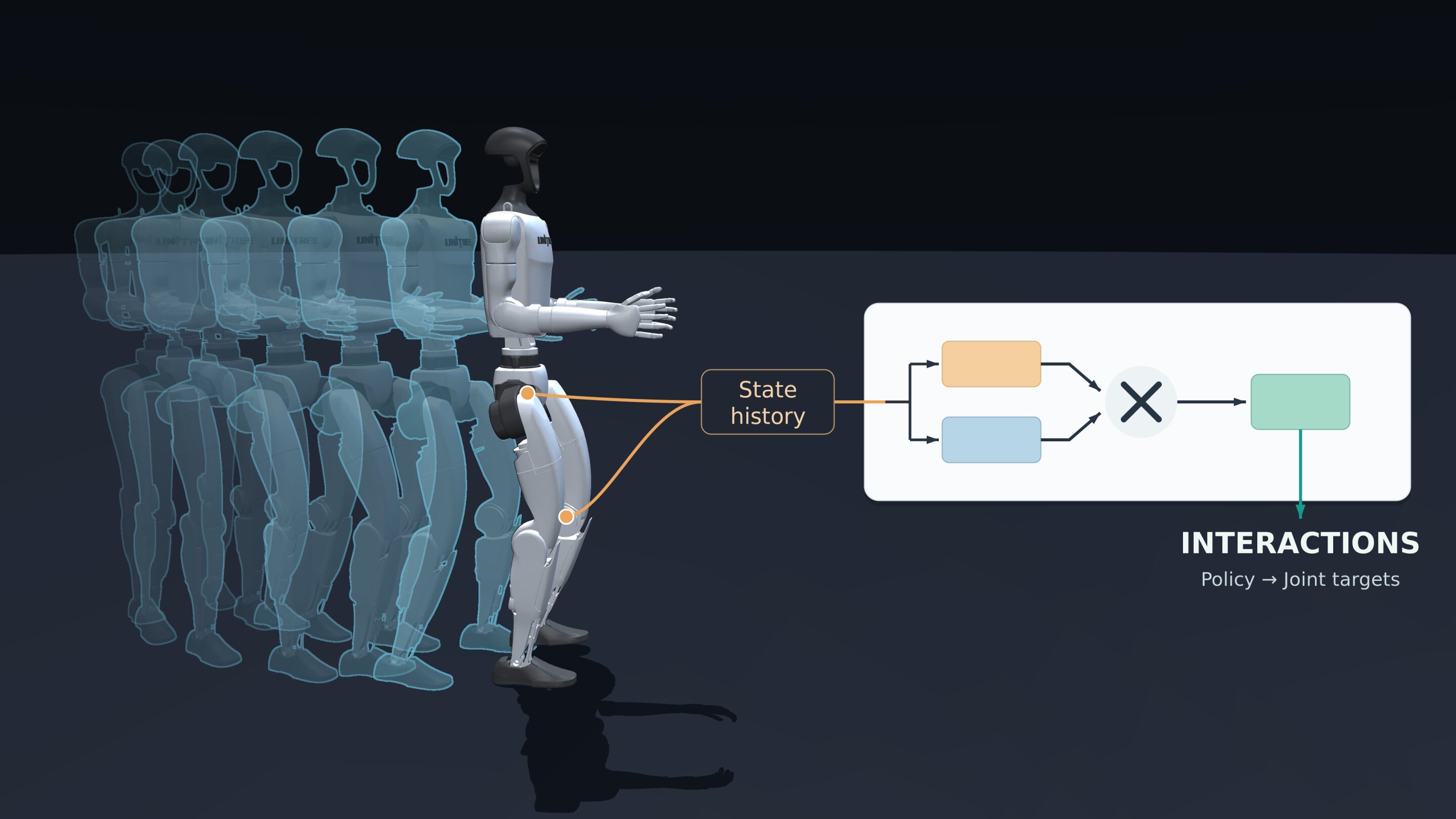
Robot movement and goals involve multiplicative relationships among physical variables. For example, the forces acting on one joint depend on the positions and velocities of other joints, while quantities such as mechanical power and contact multiply forces and motion.
Yet conventional neural networks used in robotics, called multilayer perceptrons or MLPs, do not explicitly multiply variables. Instead, they learn these interactions indirectly through simpler operations, consuming network capacity.
The new component—called PRISM (Polynomial Representations for Interaction-Structured Motor Control)—learns multiplicative interactions among sensor observations, past actions and task commands, including joint positions, velocities and desired walking speeds. This eliminates the need to specify physical equations or manually select variables to multiply.
The work is published on the arXiv preprint server and was presented at the 10th Conference on Robot Learning (CoRL 2026) in Austin, Texas.
"Many useful clues about physical interaction are already present in a robot's observations, through combinations of signals such as joint positions and velocities.
Source link