This article has been reviewed according to Science X's editorial process and policies. Editors have highlighted the following attributes while ensuring the content's credibility:
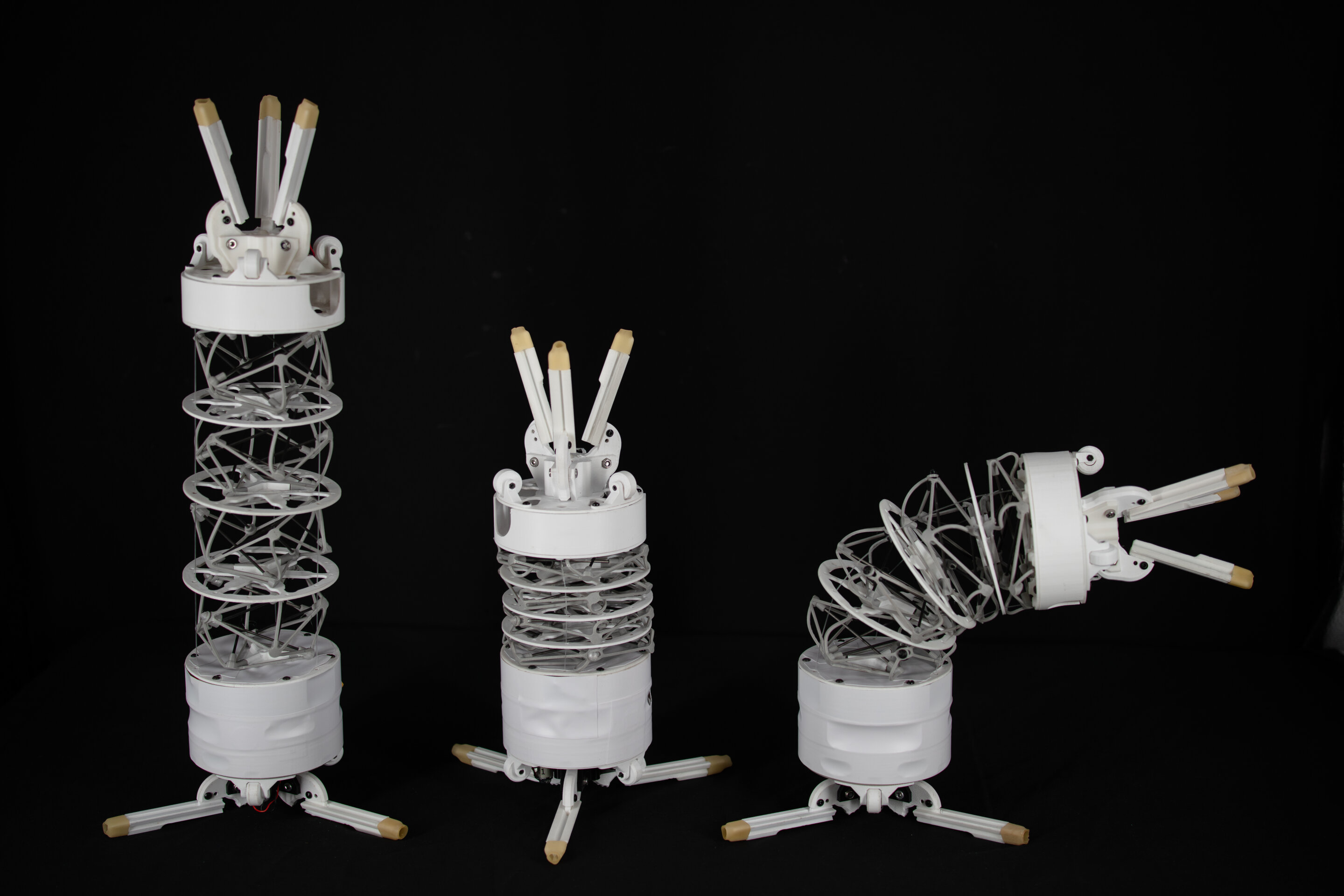
Researchers at Colorado State University have developed a flexible robot that functions like an elephant's trunk to grip objects, with a goal of one day sending teams of these machines to aid in space exploration or to help with any number of other complex tasks.
The robots are described in Nature Machine Intelligence and are designed to address limitations in current robotic systems, which are more commonly built from rigid blocks that limit the shapes they can form.
These new robots were made instead with a design approach called tensegrity, in which stiff rods are held in place by a web of tensioned cables rather than being rigidly locked together. This makes them flexible and lets them bend, collapse and change shape as needed. Like tentacles, they have no traditional joints yet feature a pair of gripping claws at both ends of their tubelike bodies that can attach to partner robots for teaming or to manipulate items.
The robots were developed by Associate Professor Jianguo Zhao and his team in the Department of Mechanical Engineering at CSU. He described the robots as generalists that could one day help with search-and-rescue efforts or support humans in a manufacturing setting, among other examples.
"Often the physical structure of robots is fixed, but our approach allows these flexible systems to adapt their shape to their environment and to the potentially changing needs of their mission by collapsing, stretching or grasping," he said.
Source link