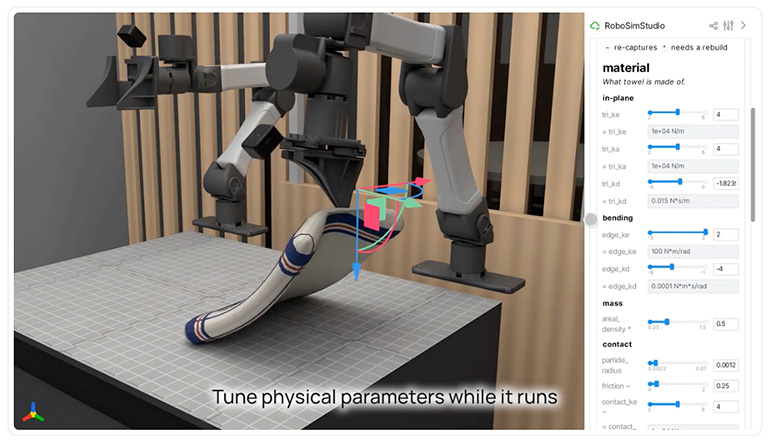
The new RoboSimStudio is an open-source project that enables agentic AI coding of robotic simulation environments. | Credit: UC Berkeley
UC Berkeley and NVIDIA have released open-source tools for a new approach: enabling teams of AI coding agents to write, simulate, and refine readable robot programs.
Since the early days of industrial robots, programming, tuning, and troubleshooting robotic workcells has taken weeks to months. New research coming out of UC Berkeley has demonstrated that new agentic AI programming tools could change how industrial robots are coded and maintained.
Why is this important? As anyone who’s programmed an industrial workcell knows, implementing the code has to wait until the end of the design and fabrication process. The robot needs to be installed in the workcell; all of the feeders, conveyance, and other elements also need to be installed. The pressure to get this done all falls on the software team, often when the project deadline is looming.
The new toolset goes beyond the idea of “vibe coding” a robot application. While it generates code with large language models (LLMs), what’s novel is the use of AI agents to manage the coding, testing and deployment.
“Agentic robotics is a fundamental shift in how robots are programmed,” said Ken Goldberg, the William S. Floyd Jr. Distinguished Chair in Engineering at UC Berkeley.
Source link