This article has been reviewed according to Science X's editorial process and policies. Editors have highlighted the following attributes while ensuring the content's credibility:
Drones are now commonly used in areas that are difficult for humans to access, but these spaces often have small or awkwardly shaped regions that are also difficult for drones to access. Some designs have attempted to overcome these limitations with shape-changing mechanisms that require extra motors or special thrust maneuvers, but these usually add complexity or restrict movement in other ways.
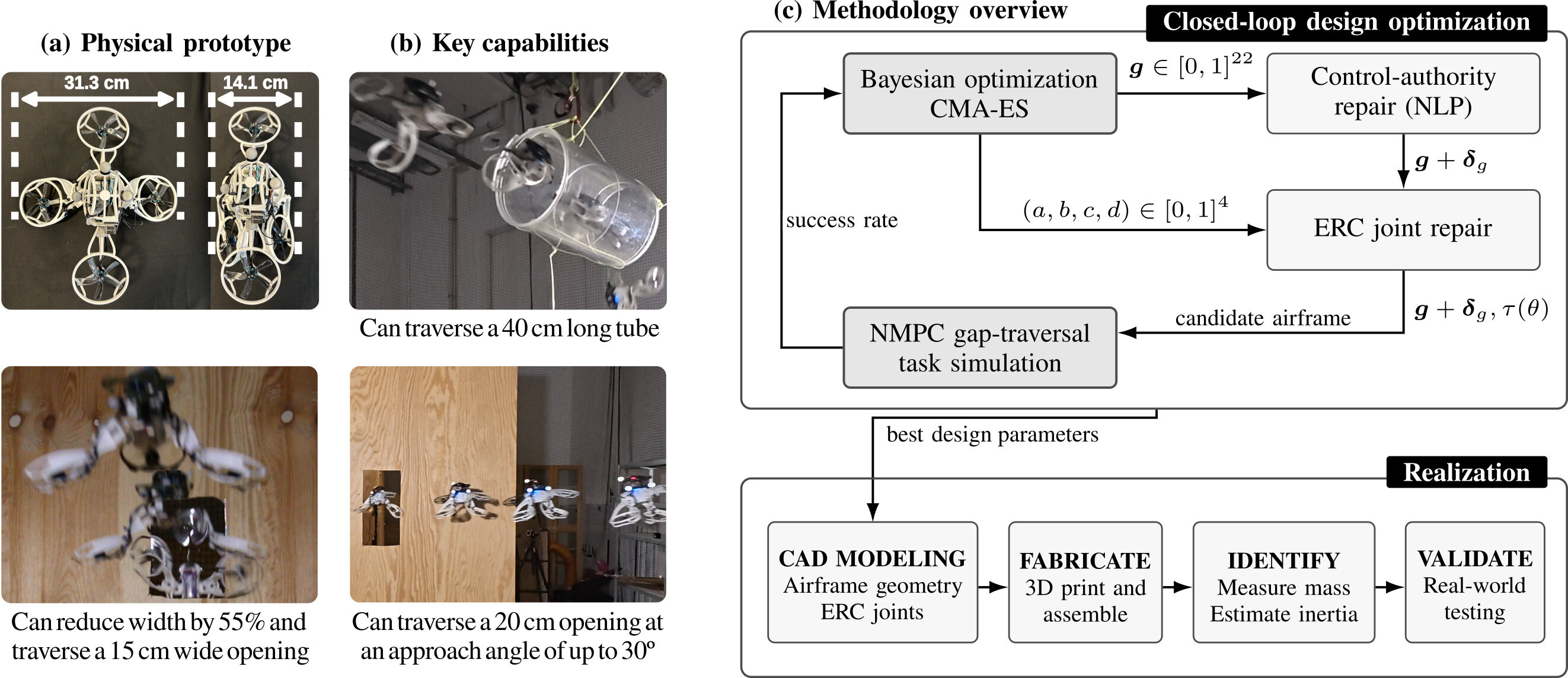
Now, a team of researchers in Europe has created a prototype capable of folding its arms to fit through smaller spaces, reducing its width by 55%. Folding drones aren't a new concept, but past designs had only reached up to 29% width reduction. In their preprint arXiv paper, the team describes how they used an automated search to test a series of designs before finding this optimized version.
To come up with the successful design, the team used a "closed-loop design optimization method," which optimized both the body shape and passive joint compliance of the drone through a series of simulations. This automated search method tested candidate designs by simulating contact between the arms and edges, folding of the arms, passage through various openings and recovery upon exit. Then, they used the best-performing candidate to guide further designs each time.
The team then built their selected design using 3D-printed parts and spring-loaded joints that stand up to normal flight forces but fold during contact with the edges of small openings.
Source link