This article has been reviewed according to Science X's editorial process and policies. Editors have highlighted the following attributes while ensuring the content's credibility:
A humanoid AI system has been developed that learns jointly from separately collected locomotion and object-manipulation data to perform multiple stages of a task in sequence.
A research team led by professor Songhwai Oh of the Department of Electrical and Computer Engineering at Seoul National University College of Engineering has developed RISE (Responsibility-Induced Specialized Experts), a vision-language-action (VLA) framework that learns jointly from locomotion and object-manipulation demonstrations collected independently and enables a humanoid robot to perform multistep tasks sequentially.
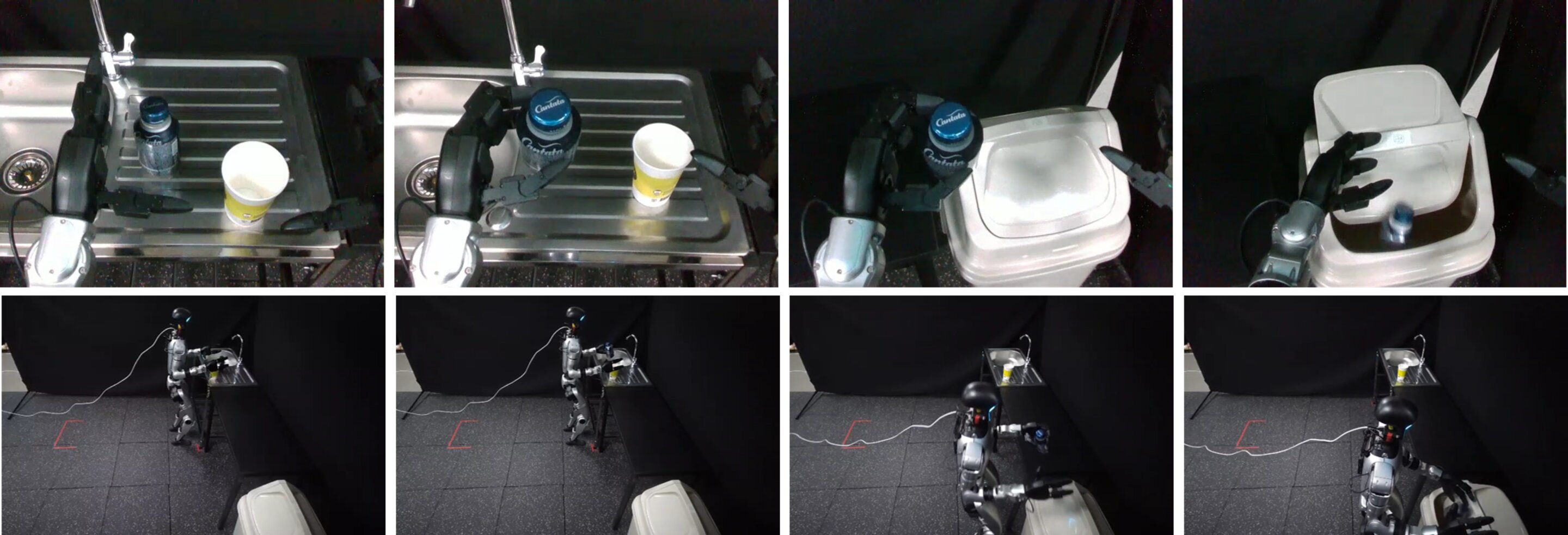
The team connected locomotion and object manipulation without requiring additional demonstrations of multistep tasks involving transitions between the two behaviors, and validated the framework in both simulation and experiments using a real humanoid robot, the Unitree G1.
The research was accepted for the IEEE/RSJ International Conference on Intelligent Robots and Systems (IROS 2026).
In recent years, vision-language-action (VLA) technology, which enables robots to jointly understand camera images and natural-language instructions and generate physical actions, has attracted growing attention in robotics. VLA is an AI model that allows a robot to understand its surroundings, interpret instructions such as "pick up the object and move it to the designated location," and act accordingly.
Humanoid robots must perform multiple actions sequentially, such as walking, picking up objects and moving them. In practice, however, locomotion and object manipulation involve substantially different joints and movement characteristics, making it difficult for a single AI model to learn both reliably.
Source link