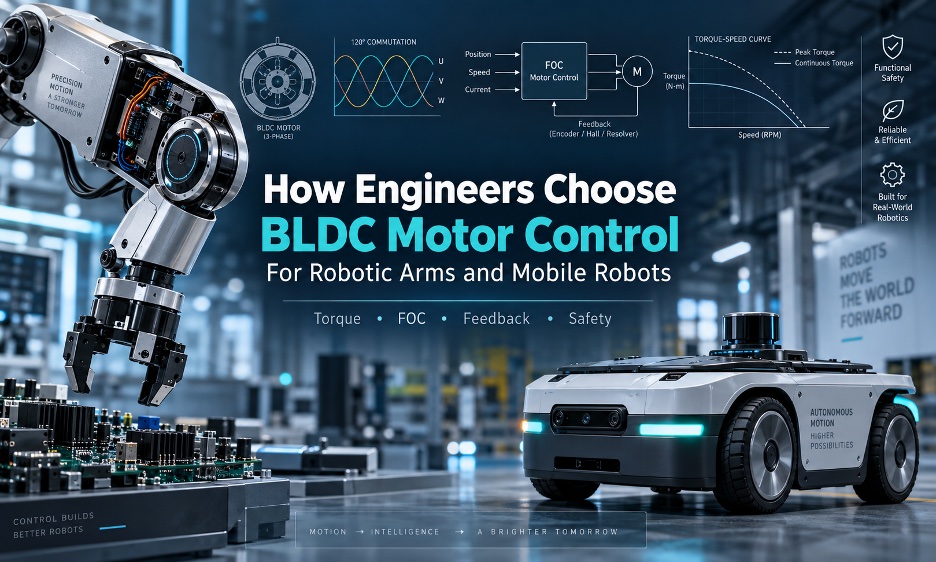
There are several factors to choosing brushless DC or BLDC motors for robots. Source: Faisal Mahmood
Selecting a brushless DC, or BLDC, motor for robotic arms or mobile robots starts with the mechanical system, not the controller catalog. A motor rated for a particular voltage and wattage does not tell an engineer whether it can deliver the required torque at low speed, regulate position accurately, absorb regenerative energy, or survive the thermal duty cycle.
The actuator is a system. The motor, inverter, current sensors, rotor position feedback, gearbox, brake, output encoder, thermal path, communications interface, and higher level robot software all influence the result.
An industrial or collaborative robotic arm joint generally prioritizes controllable torque, low-speed smoothness, position accuracy, collision response, backdrivability, and thermal performance. A mobile robot drive motor generally puts more emphasis on efficiency, starting torque, braking, traction, battery utilization, speed regulation, and synchronization between drive channels.
The terminology also deserves care. Commercial robotics literature often uses “BLDC” and “PMSM” (permanent magnet synchronous motor) somewhat interchangeably because both are three-phase, permanent-magnet machines driven by electronic inverters. Their back EMF waveform, winding design, controller algorithm, and feedback method still determine how a particular motor behaves.
For example, STMicroelectromics treats three-phase BLDC and PMSM control as related application areas and describes both six-step and field-oriented control architectures.
The first selection exercise is to establish what the motor actually has to do.
Source link