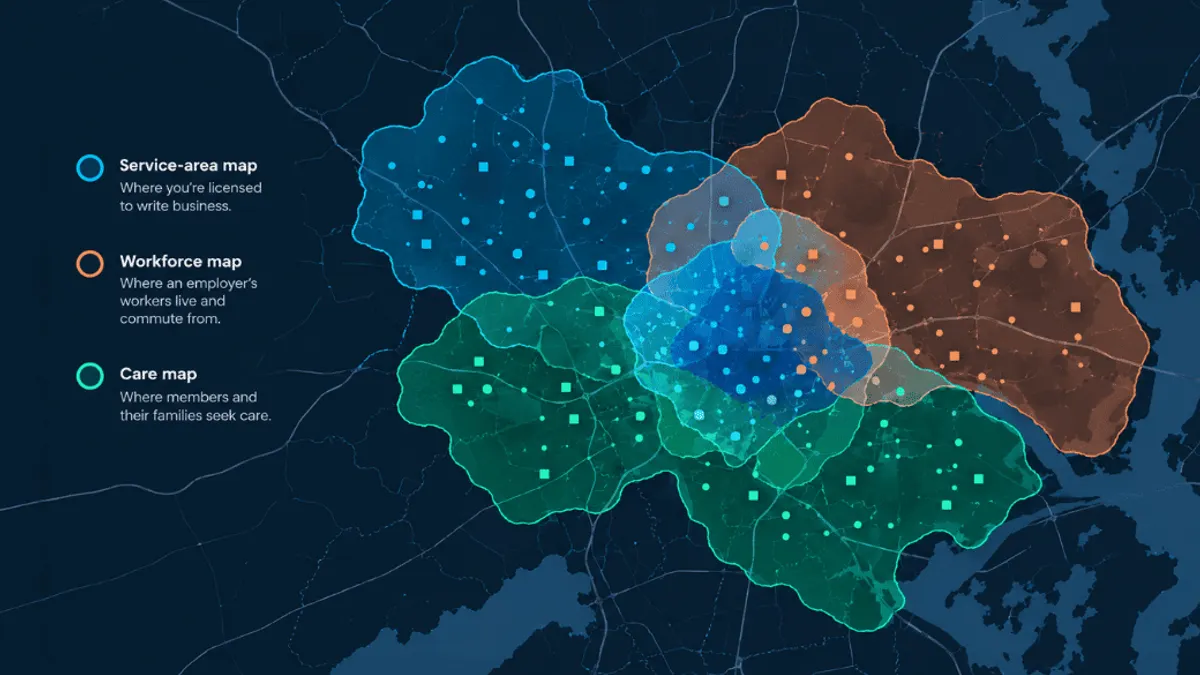
Growth planning starts with a boundary, and for most health plans, that's their service-area map: where they’re licensed, where their network sits, and where enrollment gets counted.
But that map has blind spots. It can't tell you where an employer's workers actually live, or which providers they turn to for care. Those patterns decide whether members can reach your network, and whether they stay in it.
Your service area tells you where you can sell. Your market tells you whether members can reach you and stay.
The fix is to read three maps together, not one: where you're licensed, where the workforce lives, and where members seek care.
Service-area maps still matter for licensing, contracting, and enrollment. But they only show where you can operate. To see the real market, read three maps together:
Where the three maps diverge? These are the gaps in network reach, product fit, or account strategy.
A market misjudged from the service area alone is an expensive mistake, and an easy one to make. Employer coverage is the largest source of health coverage in the country: KFF's 2025 Employer Health Benefits Survey puts the number at 154 million people under 65, with family coverage averaging $26,993 per year, of which workers pay $6,850 and employers cover the rest. For the plans competing to win that business, every employer account is an expensive bet, and the sales, network, and product budget behind it is finite.
If your budget is allocated to a market drawn without the three-map overlap, you risk building a network where there isn’t a workforce and chasing accounts your members can't reach.
Source link