This article has been reviewed according to Science X's editorial process and policies. Editors have highlighted the following attributes while ensuring the content's credibility:
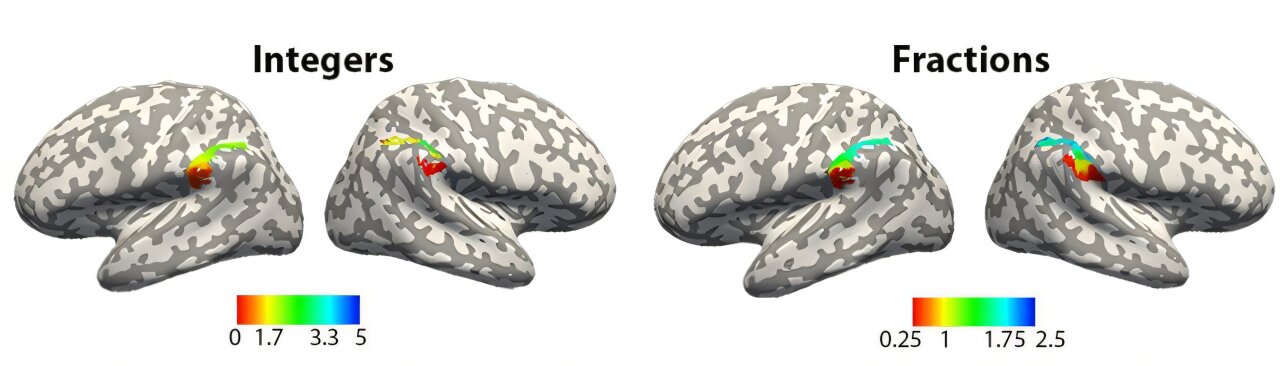
From learning to count to solving complex calculations, math requires an inherent organization of information. A team of researchers led by Stanislas Dehaene, Ph.D., and Daniela Valério, Ph.D., at the INSERM-CEA Cognitive Neuroimaging Unit (Unicog) Lab in France took dynamic brain scans of adults presented with fractions and integers. Their findings, published on Oct. 22 in the journal PLOS Biology, revealed a map of brain activity that underlies how we arrange numerical information.
One of the biggest questions in neuroscience is: How does the brain represent complex, abstract concepts? One theory is that the brain organizes related concepts together, with similar concepts represented by nearby patterns of brain activity, and the network of these distances is called a "semantic map." Numbers present an excellent case for testing the semantic map hypothesis, because these values have a universally understood arrangement.
In this study, 20 native French speakers were shown a series of integers and fractions and asked whether each number was bigger or smaller than the previous. Meanwhile, the researchers measured their brain activity with functional MRI (fMRI) to examine how patterns of brain activity changed as participants compared numbers of different sizes.
The scans revealed an organized pattern of activity in the intraparietal sulcus, a region of the brain known to be involved in numerical processing. As participants compared numbers, the patterns of activity changed in a structured way, suggesting that this region contains a spatial map of numerical magnitude ranging from smaller to larger numbers.
Source link