This article has been reviewed according to Science X's editorial process and policies. Editors have highlighted the following attributes while ensuring the content's credibility:
Tibial stress fractures are among the most common overuse injuries affecting military personnel, but they can be difficult to identify in their earliest stages. Small stresses in the bone may develop before an injury becomes apparent through conventional diagnostic tools, creating a window of opportunity for earlier detection to enable intervention.
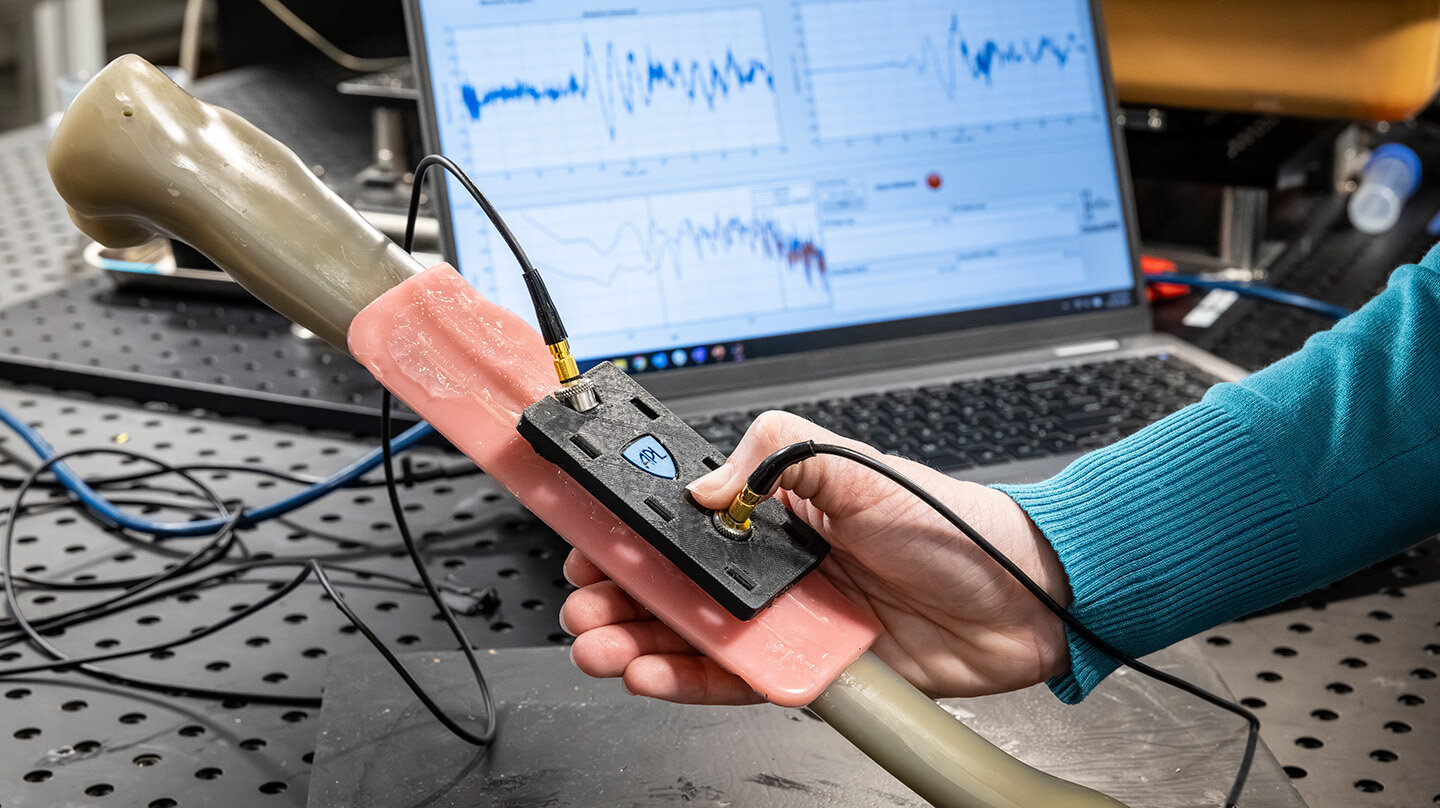
Researchers at the Johns Hopkins Applied Physics Laboratory (APL) in Laurel, Maryland, are developing Osteo Surface Echo Evaluation (OsteoSEE), a noninvasive, ultrasound-based platform that uses surface acoustic waves to identify microstructural changes and early-stage fractures in cortical bone—the dense outer layer of bone—avoiding the use of ionizing radiation. The technology was named a 2026 R&D 100 Award winner, recognizing its innovative approach to early fracture detection.
"One of the most compelling applications is supporting military readiness," said Anna Knight, OsteoSEE principal investigator and a senior biomechanical engineer at APL. "Fully developed stress fractures can be disabling to individual warfighters, and the prevalence of this overuse injury limits mission readiness across the force."
Conventional X-ray imaging can lack sensitivity to early-stage or hairline stress fractures, while advanced imaging such as MRI is more costly and requires access to specialized facilities. To address these limiting factors, OsteoSEE uses commercial off-the-shelf (COTS) ultrasound transducers to direct sound waves toward the bone at precise angles and frequencies. Rather than sending most of that energy through the middle layer of the bone, the system generates surface acoustic waves that travel along its outer layer.
Source link