This article has been reviewed according to Science X's editorial process and policies. Editors have highlighted the following attributes while ensuring the content's credibility:
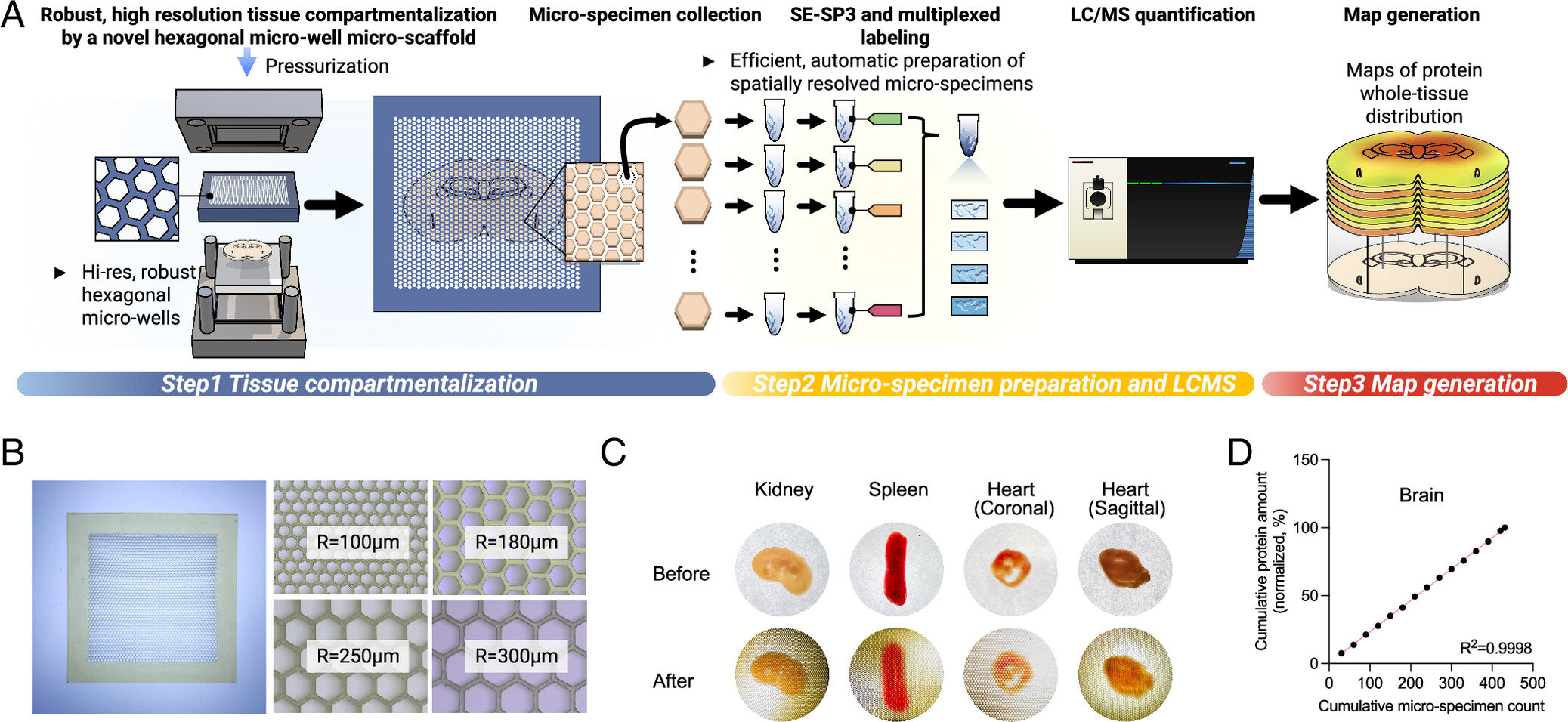
Much like a satellite provides a full picture of Earth, a new technology can generate thousands of detailed "satellite maps" showing where individual proteins are located and distributed across an entire tissue in the body or brain.
A University at Buffalo researcher has developed this technology, called hexagonal micro-scaffold assisted spatial proteomics (hex-MASP), which has the potential to transform how researchers study and create new drugs.
By mapping a drug alongside thousands of proteins, researchers can examine whether it reaches the tissue regions where it needs to act and then investigate how those regions respond to treatment. The paper is published in the Proceedings of the National Academy of Sciences.
"These insights could help uncover new therapeutic targets and guide the development of safer, more effective medicines," explains Jun Qu, Ph.D., professor of pharmaceutical sciences in the School of Pharmacy and Pharmaceutical Sciences, who developed the technology with his team.
"Each protein map tells part of the story," he says. "Seeing thousands of these maps together lets us explore how disease and treatment reshape the biological landscape of a tissue and discover patterns we never knew to look for."
The hex-MASP was applied to a mouse brain treated with monoclonal antibodies, which are medicines designed to efficiently bind specific protein targets. The technology produced detailed, accurate maps showing the distribution of both the therapeutic antibodies and more than 6,000 brain proteins across entire tissue sections.
Source link