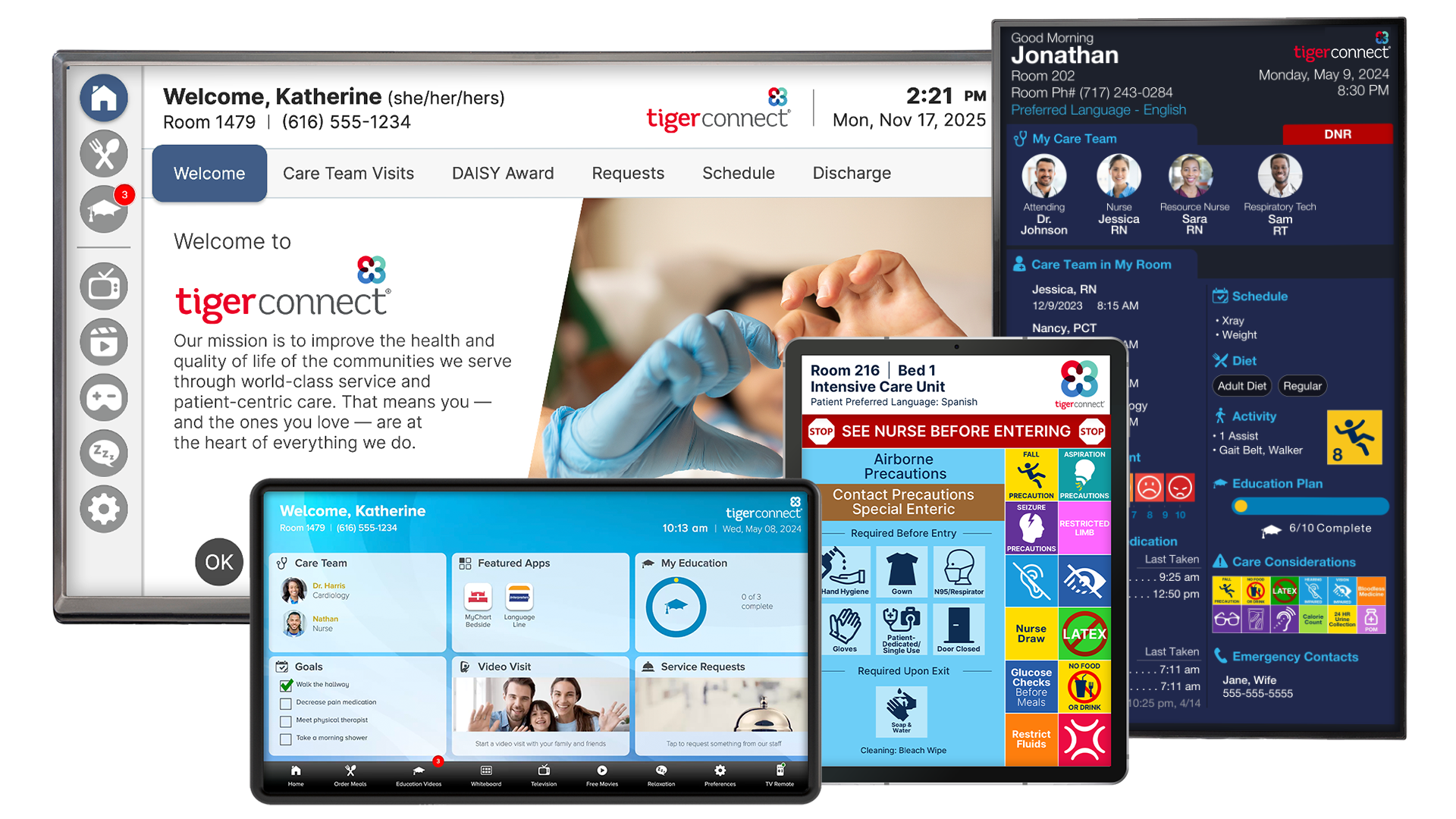
Clinical collaboration operating platform TigerConnect announced the official commercial launch of its Smart Room Suite , uniting bedside medical hardware, clinical communication, nurse call, and digital patient engagement into a unified operating layer.
The technology targets a critical patient safety hazard: systematic reviews demonstrate that 74% to 99% of hospital bedside monitor alarms require zero clinical action, contributing directly to nurse cognitive overload, desensitization, and life-threatening alarm fatigue.
The platform converges interactive patient room hardware, intelligent nurse call, cloud-native medical alarm routing, real-time location services, and virtual care integration into a unified bedside operating environment.
Designed to eliminate sensory noise and automate clinical coordination, the system connects directly with core hospital infrastructure—including Epic EHR—and embeds TigerConnect’s FDA 510(k)-cleared alarm management engine to ensure that filtered, actionable alerts reach the appropriate clinician without manual triage.
<iframe width="560" height="315" src="https://www.youtube.com/embed/QqfShtrWSCk?si=7HXyP4_TJrAVQ0pr" title="YouTube video player" frameborder="0" allow="accelerometer; autoplay; clipboard-write; encrypted-media; gyroscope; picture-in-picture; web-share" referrerpolicy="strict-origin-when-cross-origin" allowfullscreen></iframe> The clinical and operational efficacy of the Smart Room Suite has already been validated in a high-acuity inpatient setting at Lee Health’s Golisano Children’s Hospital in Fort Myers, Florida.
Lee Health modernized all 135 patient beds, including the hospital’s entire 70-bed Neonatal Intensive Care Unit (NICU), executing the full technical deployment while the unit operated above capacity:
Quantifiable Labor Recovery: The deployment reclaimed nearly 12,500 nursing hours annually across the hospital, translating to approximately $800,000 in redirected nursing capacity.
Automated Epic EHR Whiteboard Sync: In-room digital whiteboards that automatically pull care team assignments, clinical goals, dietary restrictions, and scheduled procedures directly from Epic accounted for more than 8,200 recovered nursing hours per year, eliminating manual dry-erase updates at shift changes.
Source link