This article has been reviewed according to Science X's editorial process and policies. Editors have highlighted the following attributes while ensuring the content's credibility:
Scientists have long known that capsaicin, the ingredient that makes chili peppers feel hot and is used in some pain-relief creams, works by activating a pain-sensing receptor known as TRPV1.
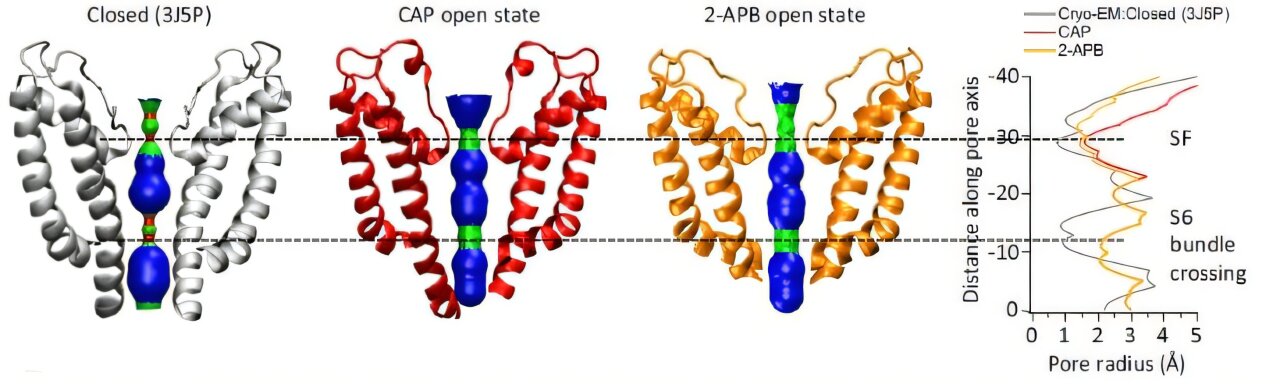
New research from the UC Davis School of Medicine reveals that the receptor does not respond to every trigger in the same way. Instead, different stimuli appear to place TRPV1 into distinct functional states. The finding opens new possibilities for more targeted pain treatments.
The study, published in PNAS (Proceedings of the National Academy of Sciences), was led by researchers in the UC Davis Department of Physiology and Membrane Biology. The findings challenge a longstanding assumption that TRPV1 adopts a single activated state regardless of what triggers it.
TRPV1 is often called the body's capsaicin receptor. Located on pain-sensing nerve cells, it detects heat, tissue injury, inflammation and chemical compounds—including the capsaicin in hot peppers.
Because TRPV1 plays a central role in pain pathways and does not involve opioid signaling, it has long been considered a potential target for developing nonaddictive pain medicines. However, efforts to block the receptor have been complicated by its equally important role in regulating body temperature.
"Researchers have generally assumed that once TRPV1 is activated, the channel enters essentially the same open state regardless of what stimulus triggered it," said first author Bo Hyun Lee, a former researcher in the Zheng Lab at UC Davis.
Source link