This article has been reviewed according to Science X's editorial process and policies. Editors have highlighted the following attributes while ensuring the content's credibility:
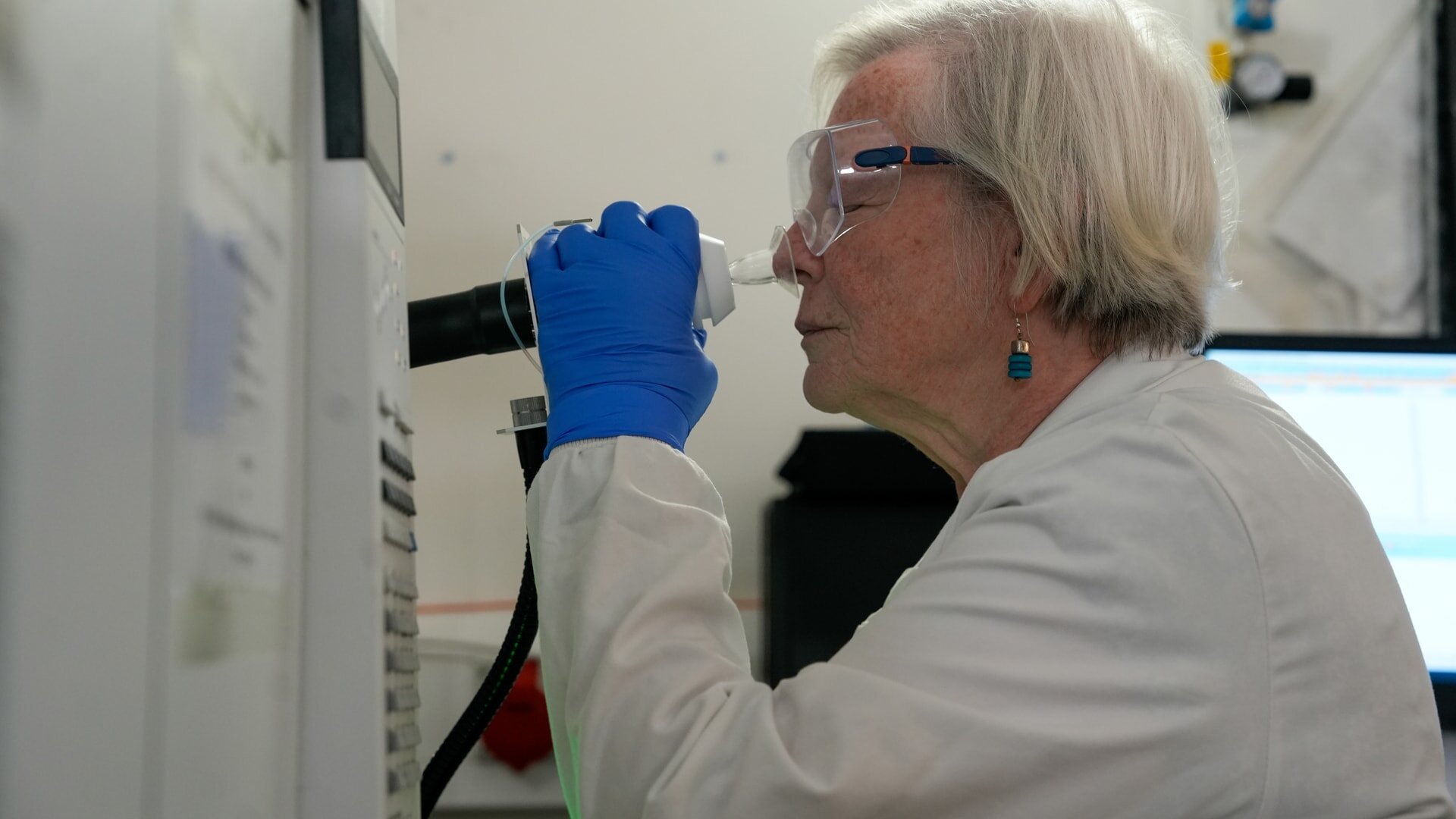
A retired nurse who noticed that people with Parkinson's had a distinct odor inspired Manchester scientists to explore changes in molecules on the skin's surface. Using a simple skin swab, they can detect about 15,000 molecular features, approximately 10% of which consistently differ in abundance between people with and without Parkinson's.
"It went from a fairly standard musky-man smell to something stronger and mustier," Joy Milne recalls of the change in her husband Les's scent. He was diagnosed with Parkinson's around 12 years later.
Milne has hyperosmia, a heightened sensitivity to smell. Throughout her career she noticed that people with illnesses smelled differently, but it was at a Parkinson's support group that it all finally fell into place: "I realized everyone else there had the same scent."
Milne later went to a talk given by professor Tilo Kunath, a regenerative neurobiologist at the University of Edinburgh. There she asked him why he wasn't working to find out why people with Parkinson's have a distinct odor. Kunath called his collaborator professor Perdita Barran, a mass spectrometry specialist, and asked if she could help.
"It sounded so extraordinary I didn't know what to think," Barran says. "We tested Joy and she really could smell Parkinson's."
The team reasoned that Milne might be detecting metabolic changes that preceded the onset of motor symptoms. In an initial study, people with Parkinson's and healthy controls wore T-shirts that Milne then assessed without seeing the participants.
Source link