This article has been reviewed according to Science X's editorial process and policies. Editors have highlighted the following attributes while ensuring the content's credibility:
Reading a sentence, following a conversation, solving a problem or deciding what to do next: all of these rely on working memory. It allows the brain to hold information in mind for a few seconds, even after the stimulus has disappeared, to be able to compare it with new information, manipulate it and use it to guide our behavior. It therefore plays an essential role in the transition from perception to thought, and from thought to action.
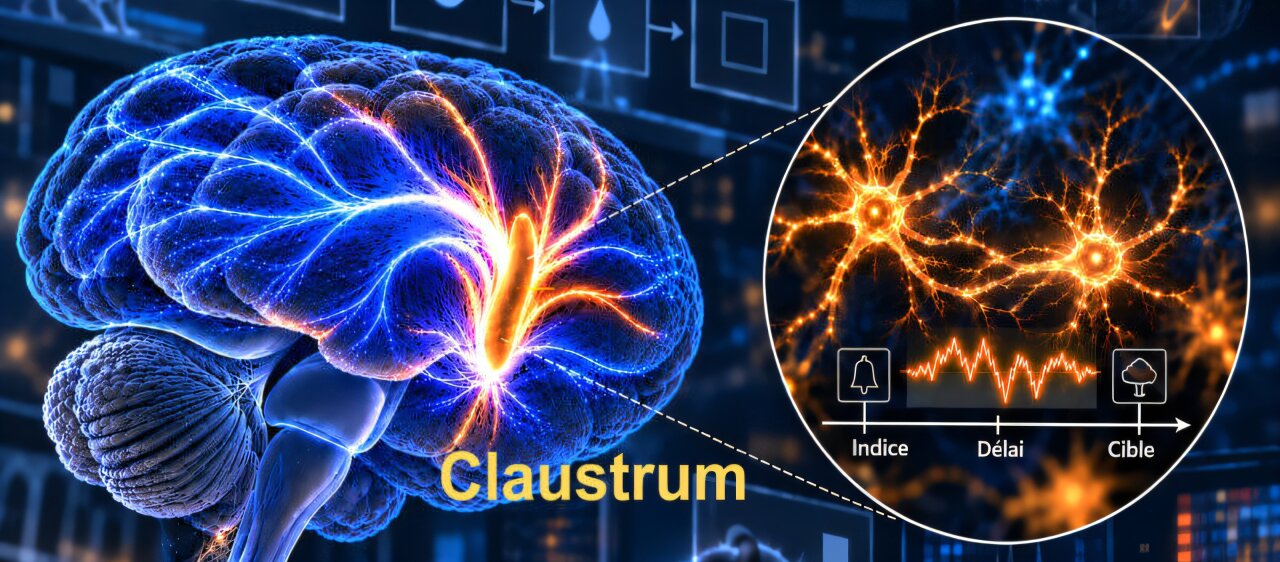
UNIGE scientists show that this function relies in part on a small, deep brain structure, the claustrum, whose neurons help keep a trace of information for tens of seconds. Moreover, inhibiting the claustrum leads to a marked drop in working memory performance.
These results, published in Nature Communications, add a piece to the puzzle of the circuits underlying thought, a key issue for disorders in which working memory is impaired, notably ADHD and schizophrenia.
Without working memory, it would be difficult to think, understand, decide or adapt our behavior. Indispensable, it is also extremely demanding for the brain. Sensory information vanishes within moments once the stimulus ends, yet its representation must remain stable enough to be used later.
How does the brain manage to retain information that is no longer there? We now know that working memory does not depend on a single brain region, but on the interaction of vast networks involving, among others, the prefrontal cortex, sensory regions, the parietal cortex, the thalamus and other subcortical structures.
Source link