This article has been reviewed according to Science X's editorial process and policies. Editors have highlighted the following attributes while ensuring the content's credibility:
Gastrointestinal fistulas are abnormal passages between the digestive tract and another organ or tissue. They are a common complication of surgery, trauma, inflammatory diseases and malignant tumors and can be life-threatening in severe cases.
Current endoscopic fistula treatments have limitations, though: Stents migrate, fistulas closed with titanium clips recur, and endoscopic suturing is technically challenging. Postoperative tissue adhesion further complicates clinical treatment. As a result, safer, more effective repair strategies are needed.
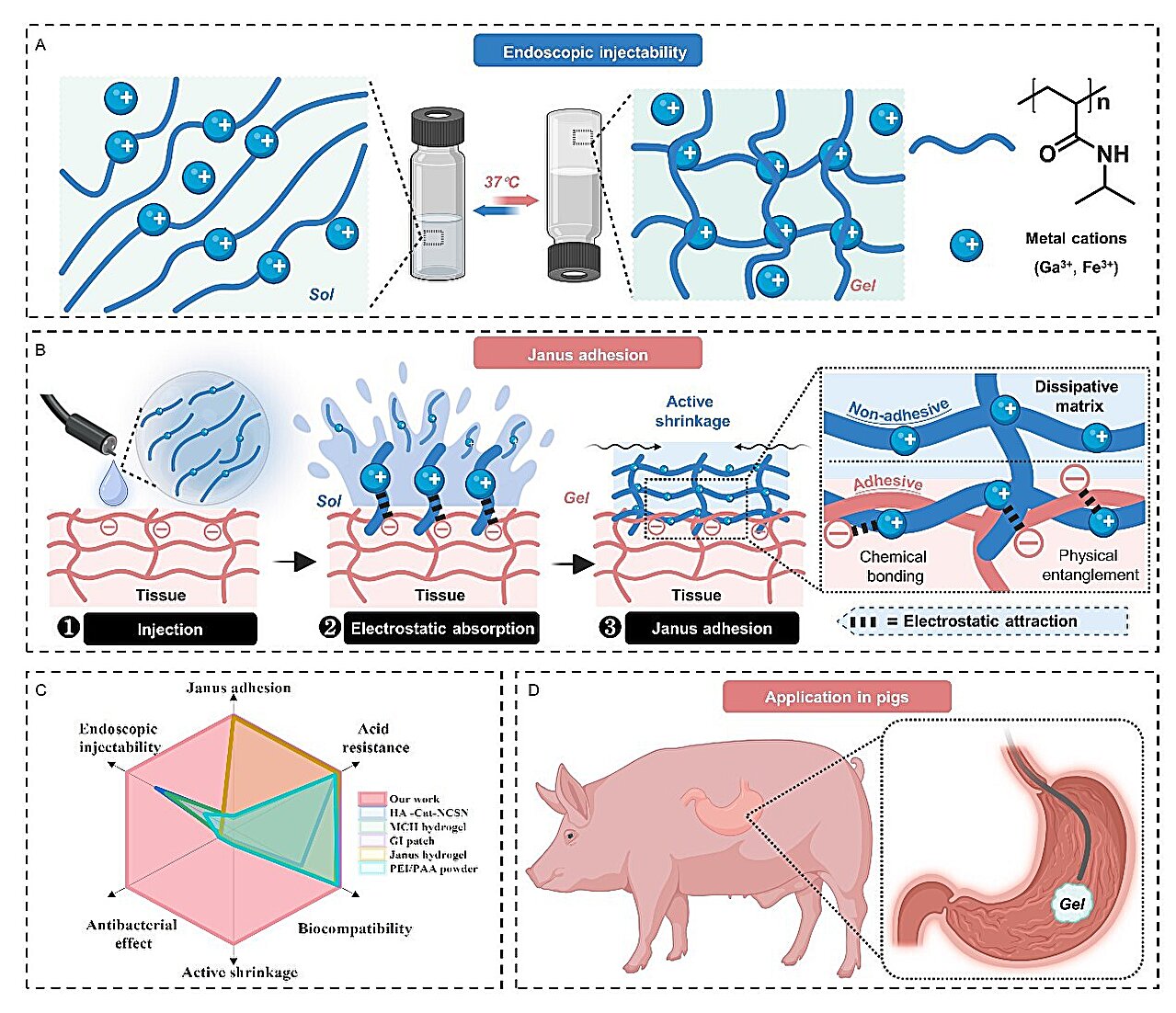
Now researchers have developed a thermoresponsive hydrogel sealant—inspired by slugs—that has proved effective at sealing gastrointestinal fistulas in animal models. The sealant, which is injected through a standard endoscope, rapidly solidifies upon entering the body, offering a new, minimally invasive way to treat gastrointestinal fistulas.
The study was led by professor Bai Shuo from the Institute of Process Engineering of the Chinese Academy of Sciences, in collaboration with Dr. Li Jingtao's team from the China–Japan Friendship Hospital.
Slugs living in humid jungles can secrete a defensive mucus that firmly attaches tree frogs to branches. This mucus is rich in positively charged proteins that adhere to wet tissue through electrostatic interactions and physical entanglement. The proteins transform from a solution into a gel under the action of metal ions and environmental factors.
Inspired by this substance, the researchers combined linear poly(N-isopropylacrylamide) (PNIPAM) with Ga³⁺ to prepare a PGaᴵᴵᴵ sealant. At 25 °C (77°F), the sealant is a transparent, flowing "mucus" that passes smoothly through a 27-gauge needle and a standard endoscopic channel.
Source link