This article has been reviewed according to Science X's editorial process and policies. Editors have highlighted the following attributes while ensuring the content's credibility:
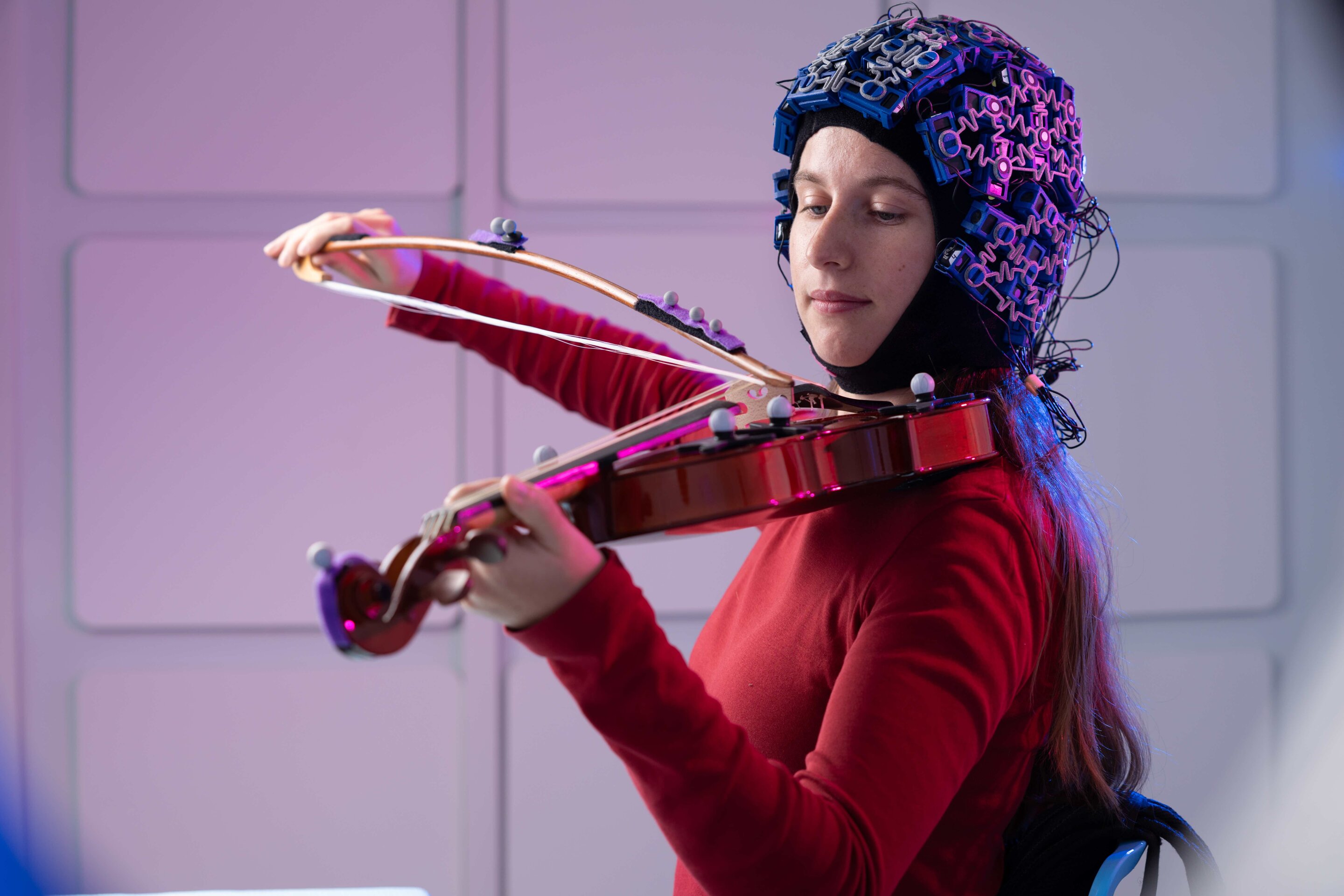
A new study using wearable brain imaging has shown what happens in the human brain when someone learns to play a musical instrument. The results revealed the patterns of brain activity that enable us to play an instrument, in this case a violin, and how having just a single lesson significantly changes those patterns of activity.
The study, led by the University of Nottingham, is published in the journal Imaging Neuroscience.
To enable this first-of-its-kind study, the team of scientists used OPM-MEG. This new type of scanner, developed in Nottingham, is integrated into a lightweight helmet, with a backpack-mounted control unit. It allows electrical brain signals to be measured and brain function characterized while a person carries out naturalistic tasks.
The researchers measured brain waves (rhythmic changes in electrical activity across groups of neurons) and how they changed throughout the violin-playing task. One of the proposed roles of these oscillations—specifically those in the so-called "beta" frequency range—is to signal information about whether our actions lead to the outcomes we expect.
"Your brain works by making predictions about what will happen as a result of your actions. So, if I am playing a violin, my brain will have an expectation of what sound it will make. If I play the expected note, my brain receives information that the outcome matched its prediction; if I hit an unexpected note, it receives information that it did not.
Source link