This article has been reviewed according to Science X's editorial process and policies. Editors have highlighted the following attributes while ensuring the content's credibility:
One of the great challenges in treating diseases like amyotrophic lateral sclerosis (ALS) is not necessarily finding a promising drug. It is getting the drug to the right place.
Nature may already have the answer. New research from the University of Georgia's Regenerative Bioscience Center (RBC) is revealing how tiny, naturally produced carriers could help deliver medicines to the cells that need them most.
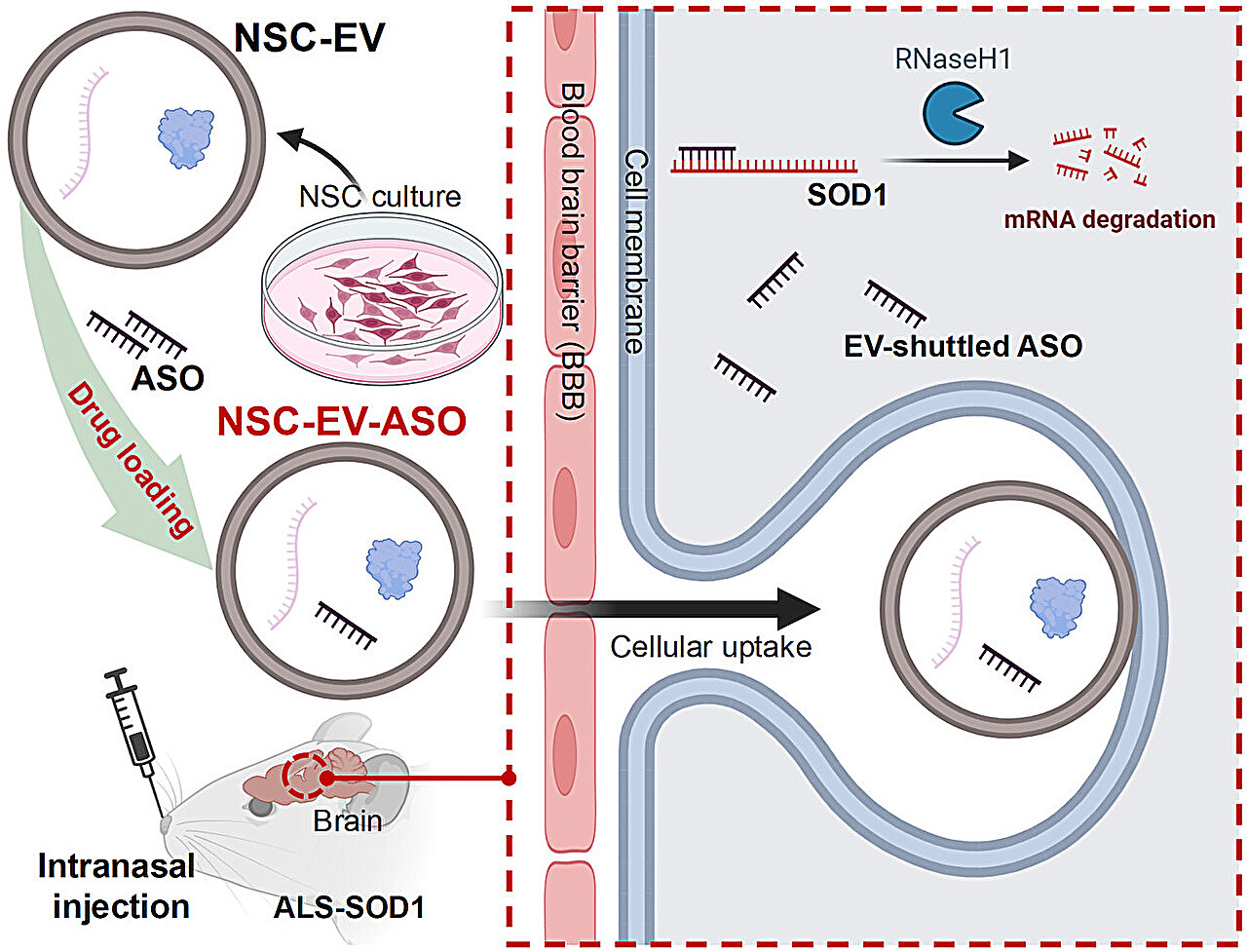
"Our research grew from a simple idea—instead of forcing a drug to find its way into the brain, give it a vehicle that already knows how to get there," said Yao Yao, an associate professor in UGA's College of Agricultural and Environmental Sciences and corresponding author of the study published in the Journal of Extracellular Vesicles.
Antisense oligonucleotides (ASOs) are drugs designed to stop specific disease-causing signals in cells, and they are emerging as a promising approach to treating ALS. But getting these treatments to the brain and spinal cord is no easy task.
ASOs do not readily cross the blood–brain barrier. The barrier can block them, cells may not readily take them up, and the body can remove or break them down before they have a chance to work. For these reasons, ASOs typically require delivery directly into the fluid surrounding the brain and spinal cord.
Neural stem cells naturally produce small fluid-filled sacs, or vesicles, that can carry molecules between cells.
Source link