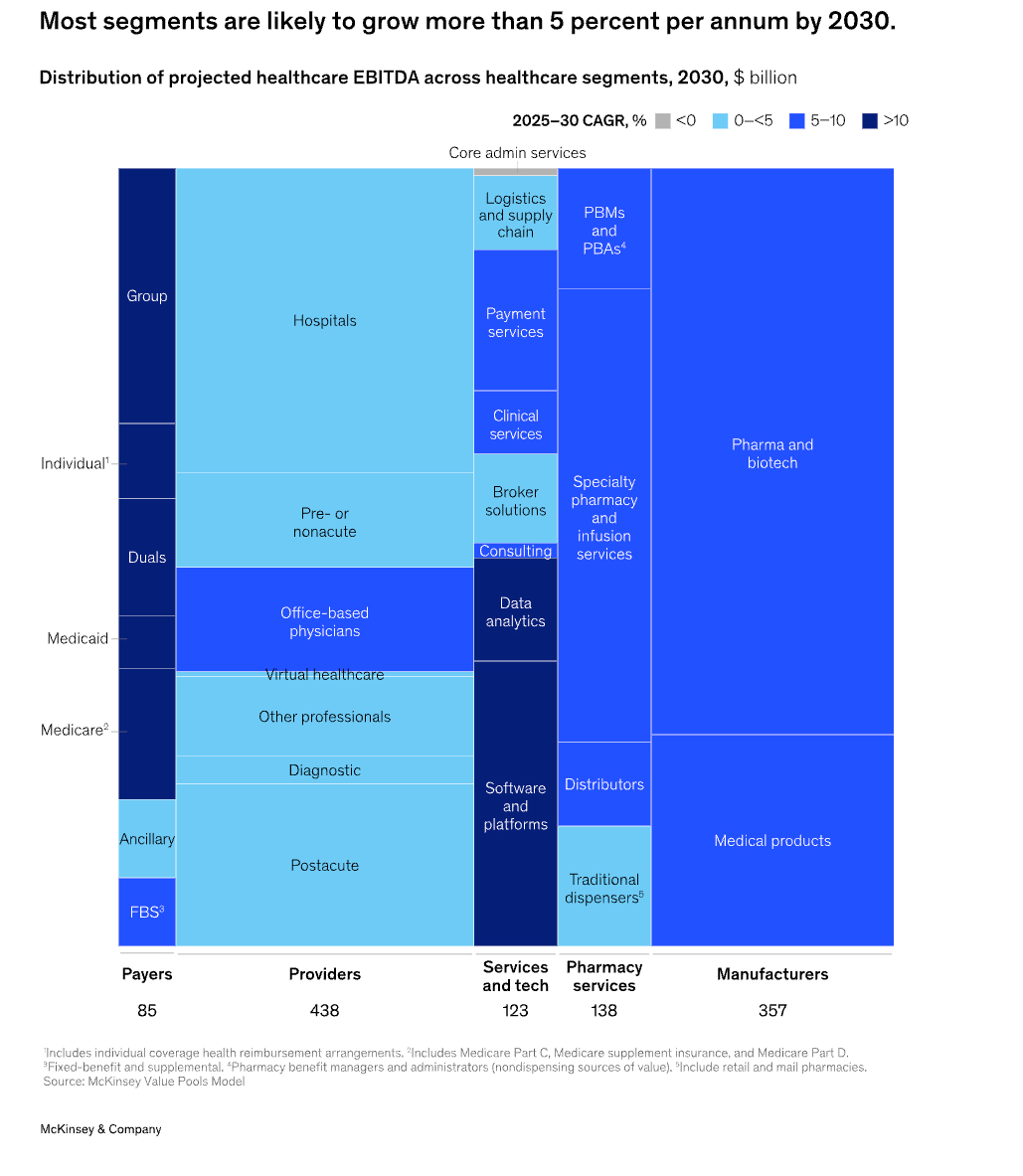
A new report from McKinsey & Company , the 2027 U.S. healthcare outlook, finds that healthcare services and technology (HST) is emerging as the industry’s fastest-growing value pool segment, with AI accelerating a shift in how companies generate revenue.
U.S. healthcare economics have experienced a historic structural reset: total provider EBITDA dropped to $241 billion in 2022 before rebounding to 350–369 billion in 2025, while total payer EBITDA collapsed from $60 billion in 2022 to just $9 billion in 2025 (turning collective risk-bearing businesses negative to $4 billion in 2025 for the first time this decade).
The 2026 U.S. federal budget deficit is forecast at $1.9 trillion (5.8% of GDP) and national debt has crossed $40 trillion, constraining federal fiscal flexibility even as healthcare delivery productivity declined ~1% annually from 2019 to 2025.
Overall healthcare EBITDA is projected to grow at a 7% CAGR from 2025 to 2030, decelerating to 4% annually through 2027 due to ACA subsidy expirations and Medicaid disenrollment before accelerating to 9% annually between 2027 and 2030.
The Capital Shift: Software Platforms and Data Ingestion vs. Legacy BPO Displacement
The expansion within HST is characterized by a stark operational divide between software-driven automation and legacy business process outsourcing (BPO):
Data, Analytics, and Cloud Infrastructure: Enterprise data and analytics platforms represent the fastest-growing subsegment, charting more than 11% annual revenue gains, followed closely by core software platforms at greater than 10%. Over the next five years, generative and agentic AI adoption is projected to add one to four percentage points of incremental top-line revenue growth annually to these categories as health systems and payers outsource complex engineering to external specialists.
Source link