This article has been reviewed according to Science X's editorial process and policies. Editors have highlighted the following attributes while ensuring the content's credibility:
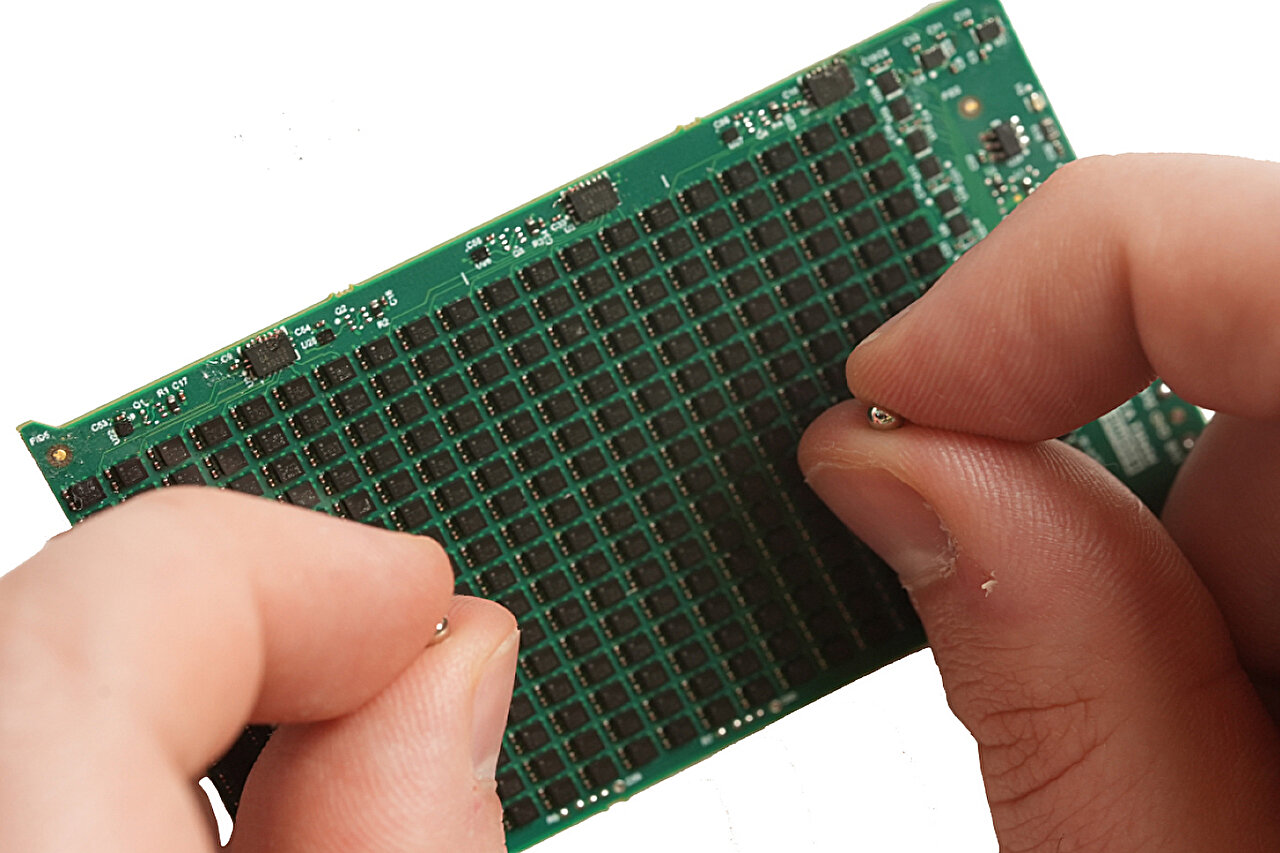
MIT researchers have shown that they can accurately track muscle movement using tiny magnetic beads implanted in the muscle. These measurements could make it easier for people with certain types of amputations to control their prosthetic limbs.
For decades, researchers have been working to develop neuroprosthetic limbs, which use neural information from muscles remaining after an amputation to guide the prosthetic limb. Measurements of a muscle's length, velocity and activation can be fed into the control algorithms that guide the limbs, allowing individuals with leg amputation to walk with a more natural gait or those with arm amputation to manipulate objects more effectively.
Until now, these devices have relied on muscle activity measurements from electrodes placed on the surface of the skin. However, those measurements have not proven reliable enough to ensure safety while walking with a neuroprosthetic leg.
The MIT team hopes that its new magnetic tracking system, which offers more accurate measurements, will enable commercial development of such limbs.
"For four decades, the standard methodology for neurally controlling prostheses has been to use skin electrodes to measure muscle activation. However, to control a prosthetic limb, joint position, torque or impedance has to be controlled, and one cannot directly determine such mechanical signals using electrical activation alone," says Hugh Herr, a professor of media arts and sciences, co-director of the K. Lisa Yang Center for Bionics at MIT, an associate member of MIT's McGovern Institute for Brain Research, and the senior author of the new study.
Source link