This article has been reviewed according to Science X's editorial process and policies. Editors have highlighted the following attributes while ensuring the content's credibility:
A signature can remain recognizable when someone writes it with their non-dominant other hand, even though different muscles have produced it. Such flexibility hints at an internal pattern for an action that can be reused in different circumstances. But does that pattern emerge only after years of practice, or can it help us learn from the start?
New research from Yale University suggests that these patterns help people improve from the outset. In 11 online drawing experiments, Zekun Sun, Zhiran Xie and Samuel D. McDougle found evidence that practicing the shared structure of a movement helps refine new actions. The findings are published in Nature Human Behaviour.
Researchers call this ability motor abstraction. Like recognizing a face from different angles, it involves preserving essential structure while setting aside details that change. For movement, those details can include which muscles are used or which direction a hand travels.
The motor system is often portrayed as machinery that executes instructions from the brain. Finding that it builds and uses abstractions would give movement control a capacity more often associated with cognition: organizing experience so it can be applied in a new situation.
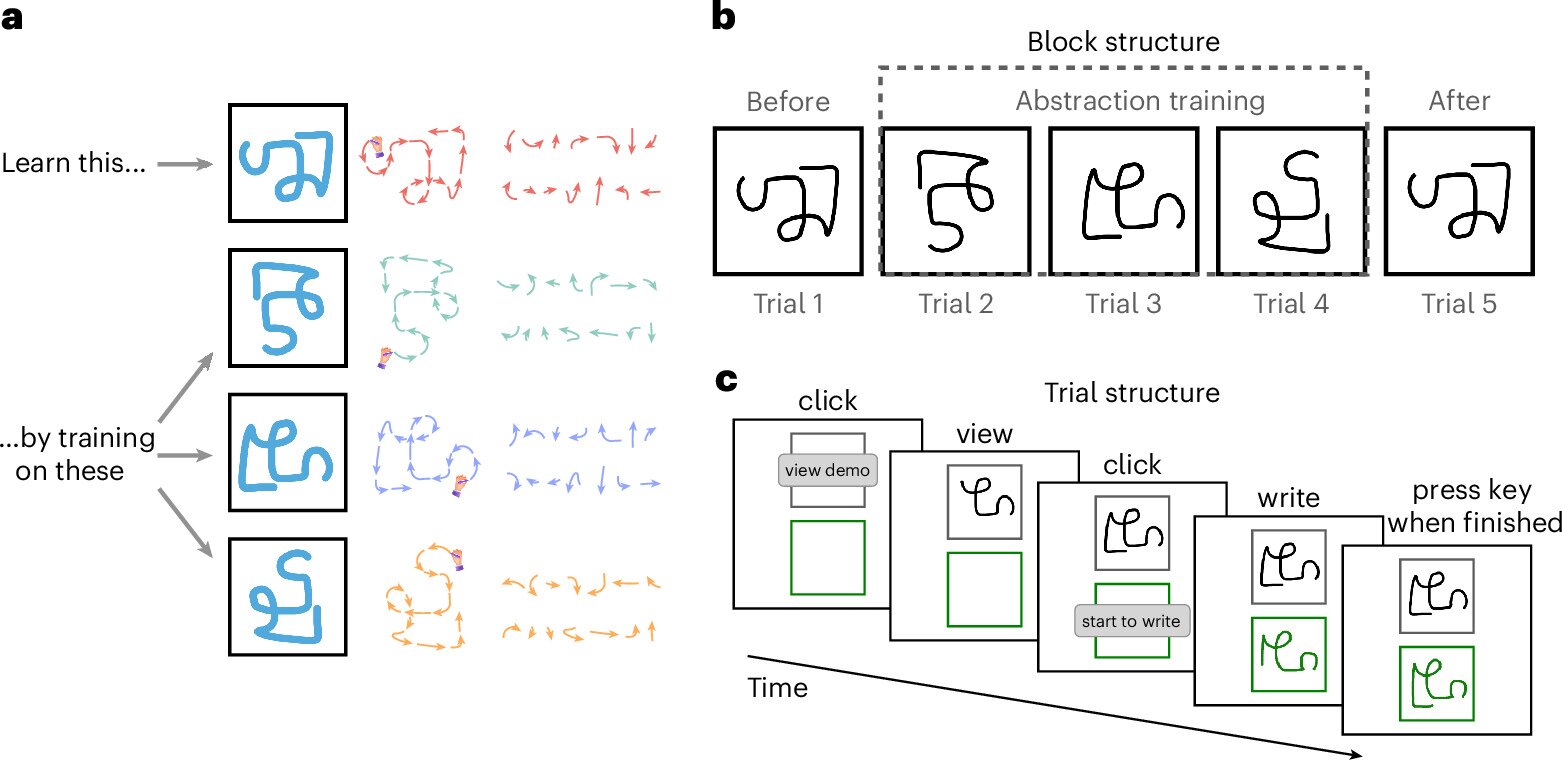
The team's crucial test was to preserve a movement's overall structure while changing the actions used to perform it. Participants copied unfamiliar symbols with a mouse or trackpad, practiced with rotated versions, then tried the originals again.
Source link