
This article has been reviewed according to Science X's editorial process and policies. Editors have highlighted the following attributes while ensuring the content's credibility:
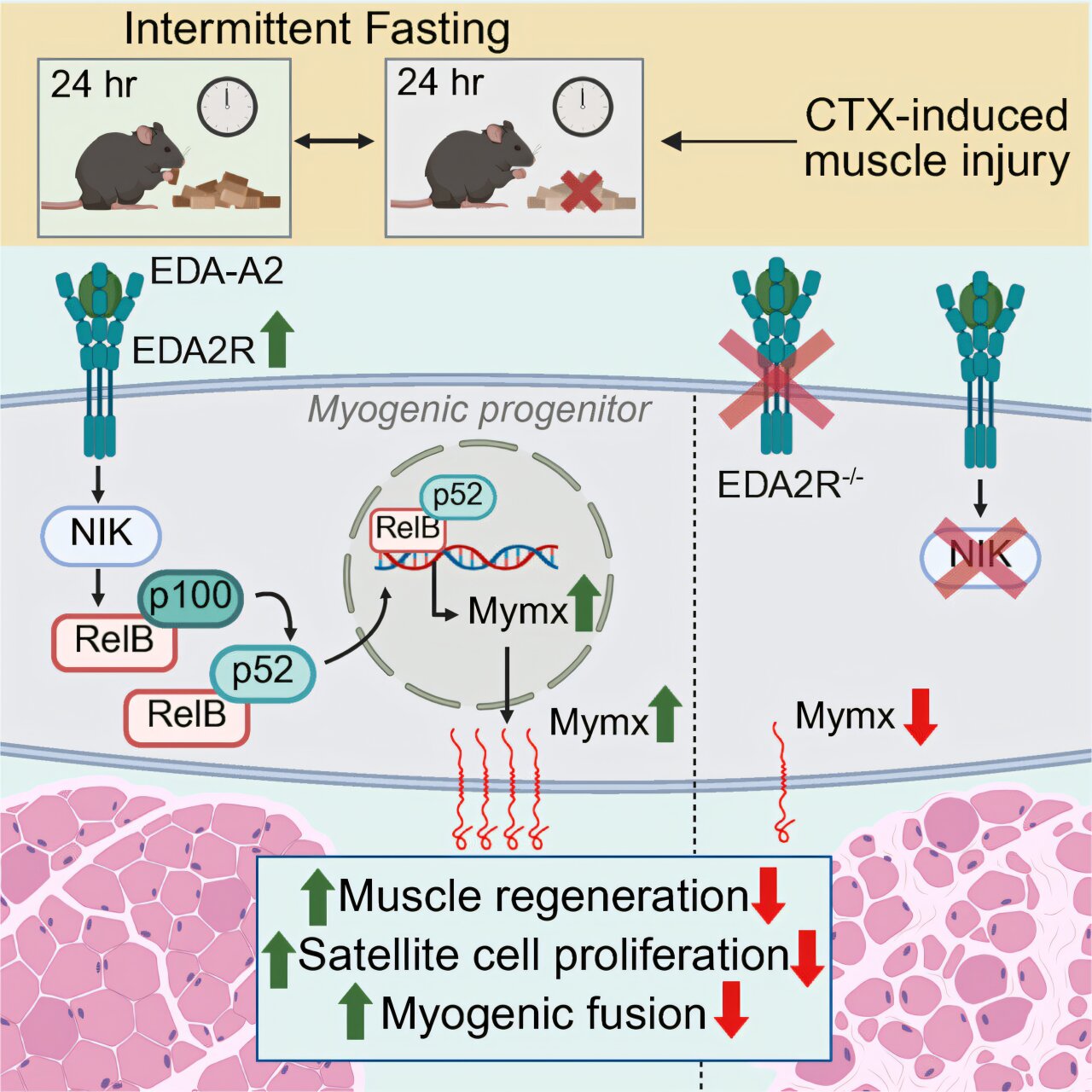
In a new study from Koç University, alternating days of fasting and feeding helped injured muscles regenerate in mice by encouraging repair cells to multiply and fuse into muscle fibers. The effect depended on a molecular pathway previously linked to muscle wasting in cancer.
The findings suggest that the same signaling machinery can contribute to rebuilding or breaking down muscle, depending on the circumstances. Dilsad H. Arabaci, Melis Sucuoglu, Serkan Kir and colleagues at Koç University in Istanbul have published the work in Cell Reports.
Muscle repair relies on adult stem cells called satellite cells. After an injury, they produce descendants that multiply and merge to form or repair muscle fibers. The researchers investigated how cyclical changes in food availability influence this process.
The researchers changed the feeding patterns of young adult male mice by alternating 24 hours without food and 24 hours of unrestricted feeding. Control mice could eat whenever they wanted. To compare recovery from similar injuries, the team injected all mice with a muscle-damaging toxin into a lower-leg muscle.
The feeding schedule began before injury and continued during recovery. Ten days after injury, the fasting group's damaged muscles had regained more weight and contained larger regenerating fibers than those of the controls. Labeling newly dividing cells showed that more of their nuclei had become incorporated into muscle fibers.
On feeding days, these mice ate nearly twice the control group's usual daily amount, largely compensating for their fasts.
Source link





