This article has been reviewed according to Science X's editorial process and policies. Editors have highlighted the following attributes while ensuring the content's credibility:
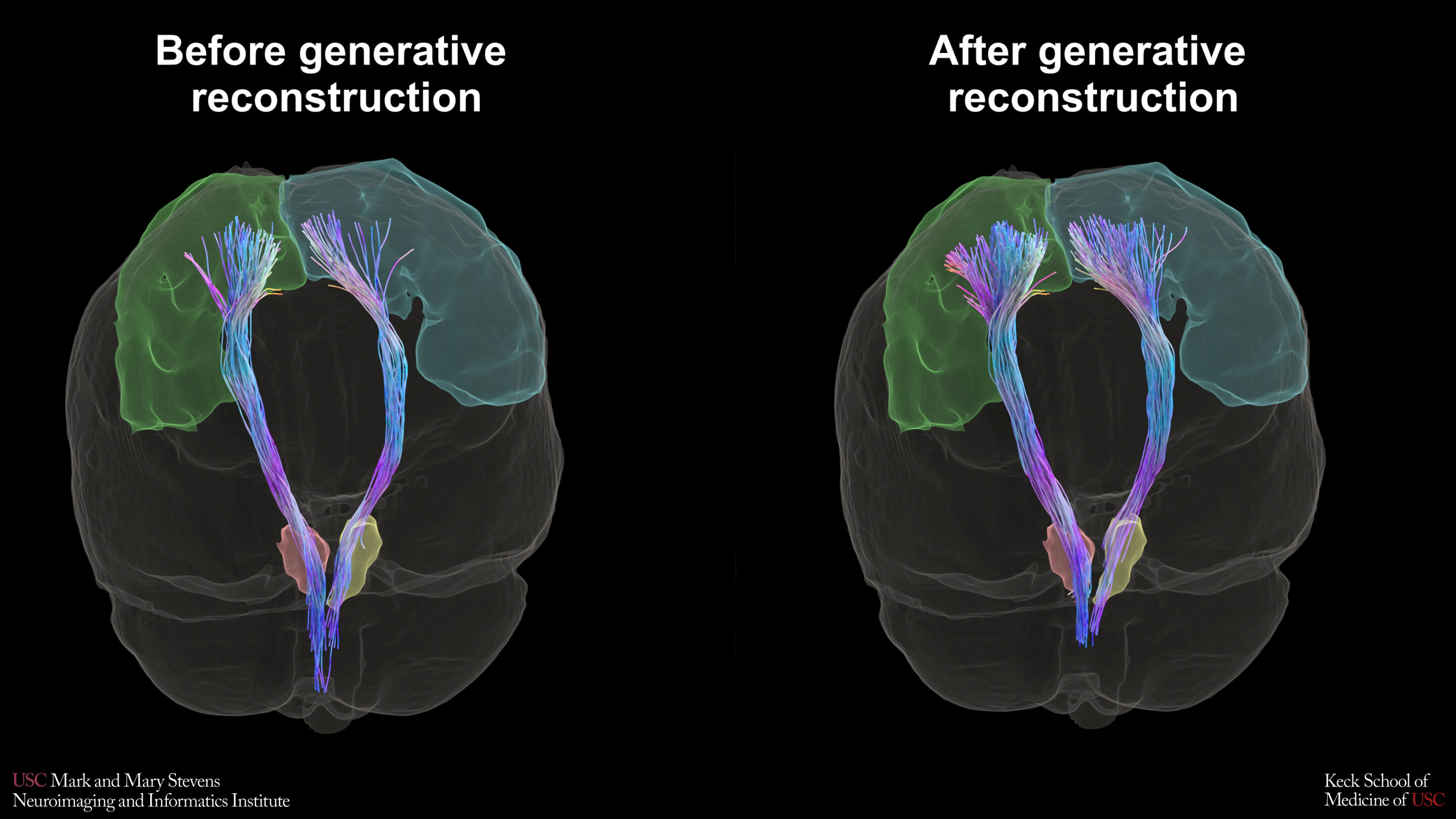
Researchers from the Mark and Mary Stevens Neuroimaging and Informatics Institute (Stevens INI) at the Keck School of Medicine of USC have developed an artificial intelligence (AI) model that helps fill gaps in brain wiring maps made with diffusion MRI, a type of scan that traces the brain's nerve fiber pathways. This could help researchers study how key brain connections change with aging and disease.
The model, described in a study published in Medical Image Analysis, targets the brainstem and the orbitofrontal region just above the eyes, two areas where distortions in the scanner's magnetic field can erase much of the signal.
The team trained and tested the model using scans from 1,315 participants in the UK Biobank and 679 participants in the Lifespan Human Connectome Project Aging study (HCP-Aging), two large studies of mostly older adults.
"In a few parts of the brain, MRI scans can come back with pieces of information missing, a bit like a photo with a corner torn off," said Shuo Huang, co-first author of the study and a postdoctoral fellow at the Stevens INI. "Our model looks at the intact tissue around each gap, along with what it learned from scans without those gaps, and estimates what most likely belongs there."
Diffusion MRI tracks how water moves through brain tissue. Because water tends to move along nerve fibers, the scans reveal the paths fibers take and how brain regions connect.
Source link