
This article has been reviewed according to Science X's editorial process and policies. Editors have highlighted the following attributes while ensuring the content's credibility:
Common intravenous anesthetics such as propofol and etomidate usually require additional pain medicines. Propofol and etomidate enhance GABA-A receptors, which act as brakes on nerve-cell activity, but generally do not relieve pain at nonsedating doses. In addition, propofol is known to commonly cause low blood pressure and slowed (or sometimes stopped) breathing, while etomidate can cause adrenal suppression by lowering cortisol production, potentially causing severe or life-threatening effects. Therefore, researchers are looking for suitable alternatives.
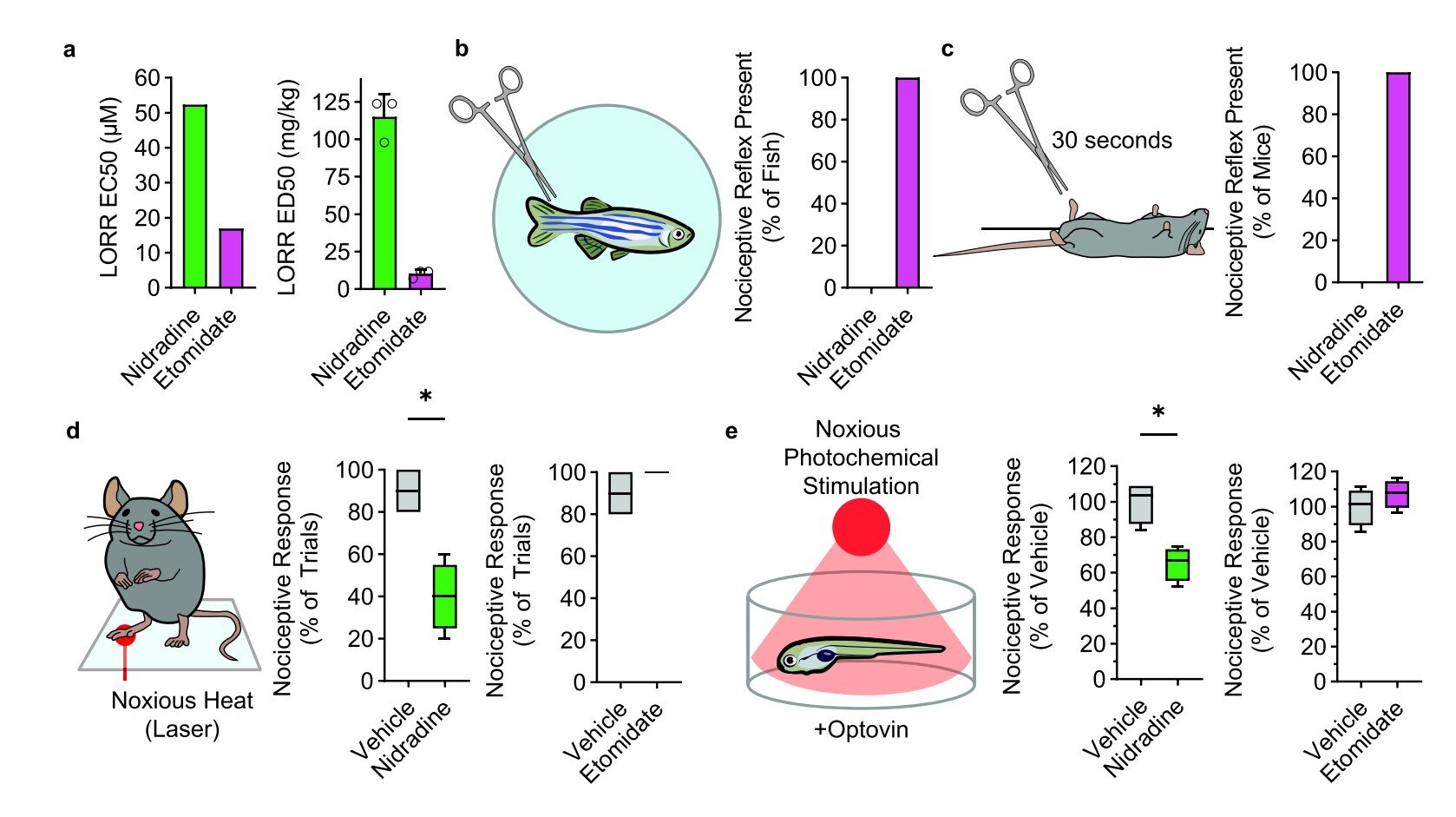
Now, a study published in Nature Communications reports that researchers have developed a promising new experimental anesthetic. The new anesthetic has thus far been effective in both zebrafish and mice—and even reduces pain responses in both animals while they are awake.
Screening for compounds and testing thousands of potential anesthetics directly in mammals is slow and costly. But the authors of the new study say a slightly different approach can help narrow down which compounds should go on for testing in mammals. The approach involves tiny zebrafish larvae, which were previously shown to produce recognizable behavioral patterns when exposed to certain drugs.
The authors of the new study write, "The fact that immersion dosing in these animals rapidly attains near-steady-state exposure in vivo facilitates chemical screens. In neuroactive discovery, a focused zebrafish larval photomotor-response screen (~374 compounds) identified reversible anesthetics like sedative–hypnotics with activity spanning GABAA, neuronal nicotinic, and NMDA receptors, illustrating that target-agnostic phenotypic assays can identify hits, including those that act through multiple targets.
Source link





