This article has been reviewed according to Science X's editorial process and policies. Editors have highlighted the following attributes while ensuring the content's credibility:
The age at which a woman experiences menopause and her reproductive history may be associated with how quickly she ages biologically, according to a study led by researchers from the Yong Loo Lin School of Medicine, National University of Singapore (NUS Medicine).
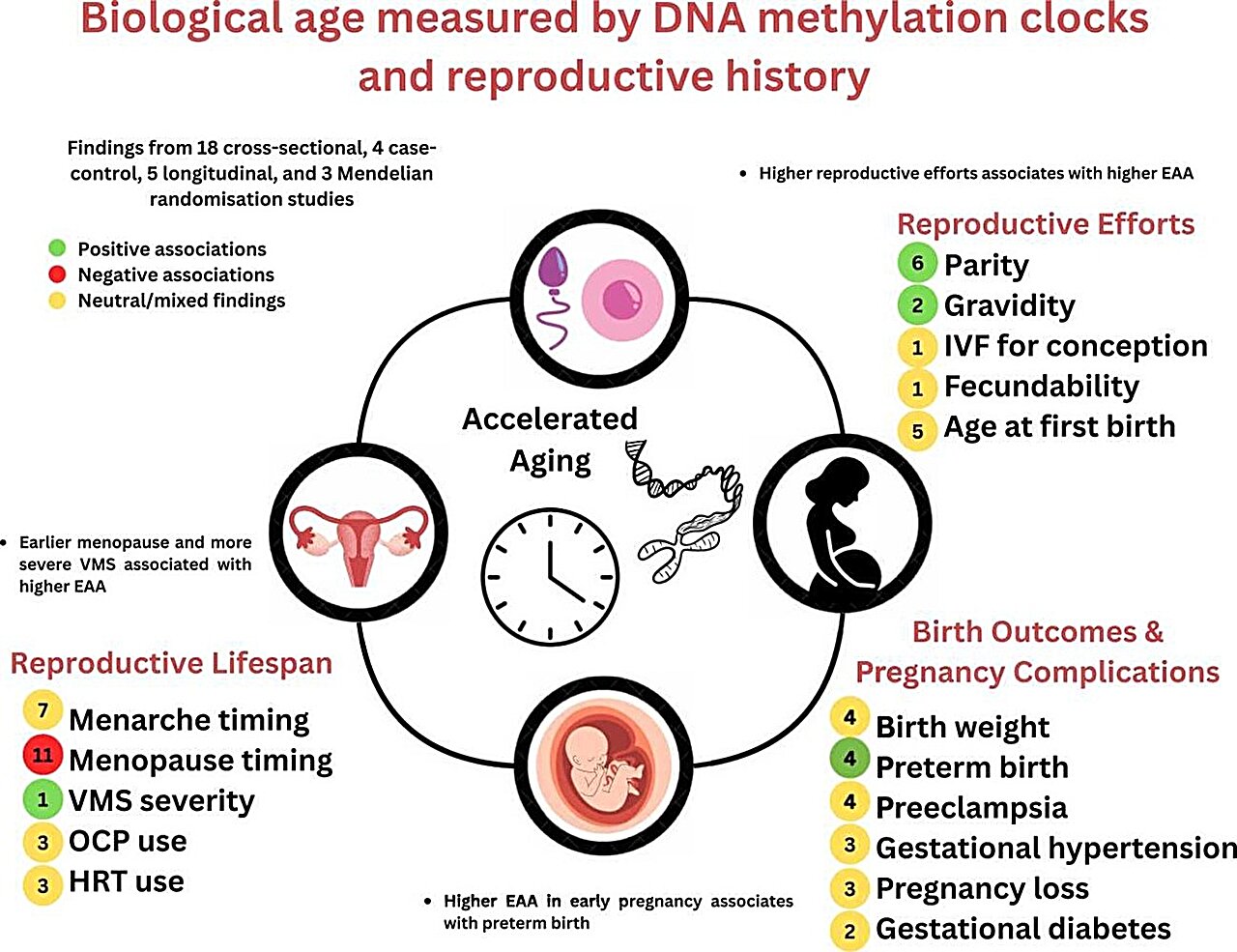
The study, published in Mechanisms of Ageing and Development, brought together evidence from 29 previously published studies involving 550,550 women to examine whether reproductive milestones, pregnancies and birth outcomes were associated with biological aging measured using DNA methylation (DNAm) clocks.
DNAm clocks estimate biological aging by analyzing chemical changes to human DNA that accumulate over time, providing an indication of how old the body appears biologically compared with a person's actual age. Researchers can use these measurements to calculate epigenetic age acceleration (EAA), which reflects whether biological aging appears faster or slower than expected. This does not mean that every organ or system has literally aged by the same amount. The study found that earlier menopause showed one of the clearest associations with greater EAA.
In the meta-analysis, each one-year earlier age at menopause was associated with approximately 0.08 years, or about one month, of greater EAA when measured using GrimAge, one of the newer-generation DNAm clocks. This analysis included 5,920 women. Similar associations were also found using the Horvath1Age and PhenoAge clocks.
Professor Andrea Maier, Oon Chiew Seng Professor in Medicine, Healthy Ageing and Dementia Research, corresponding author of the study and director of the NUS Academy for Healthy Longevity at NUS Medicine, said, "Women's reproductive history forms an important part of their health across the life course.
Source link