This article has been reviewed according to Science X's editorial process and policies. Editors have highlighted the following attributes while ensuring the content's credibility:
Between August 2024 and June 2025, Réunion Island experienced a massive chikungunya epidemic, with more than 54,000 confirmed cases and 43 deaths. It was the island's second major chikungunya virus outbreak, after the 2005–2006 epidemic, which affected about a third of the island's population.
Chikungunya is a mosquito-borne virus transmitted by Aedes mosquitoes. While rarely fatal, it causes severe joint pain that can persist for months or years. In 2025, the Réunion epidemic lineage reached other Indian Ocean islands and, over the summer, fueled unprecedented numbers of cases in more temperate regions of Europe and in China.
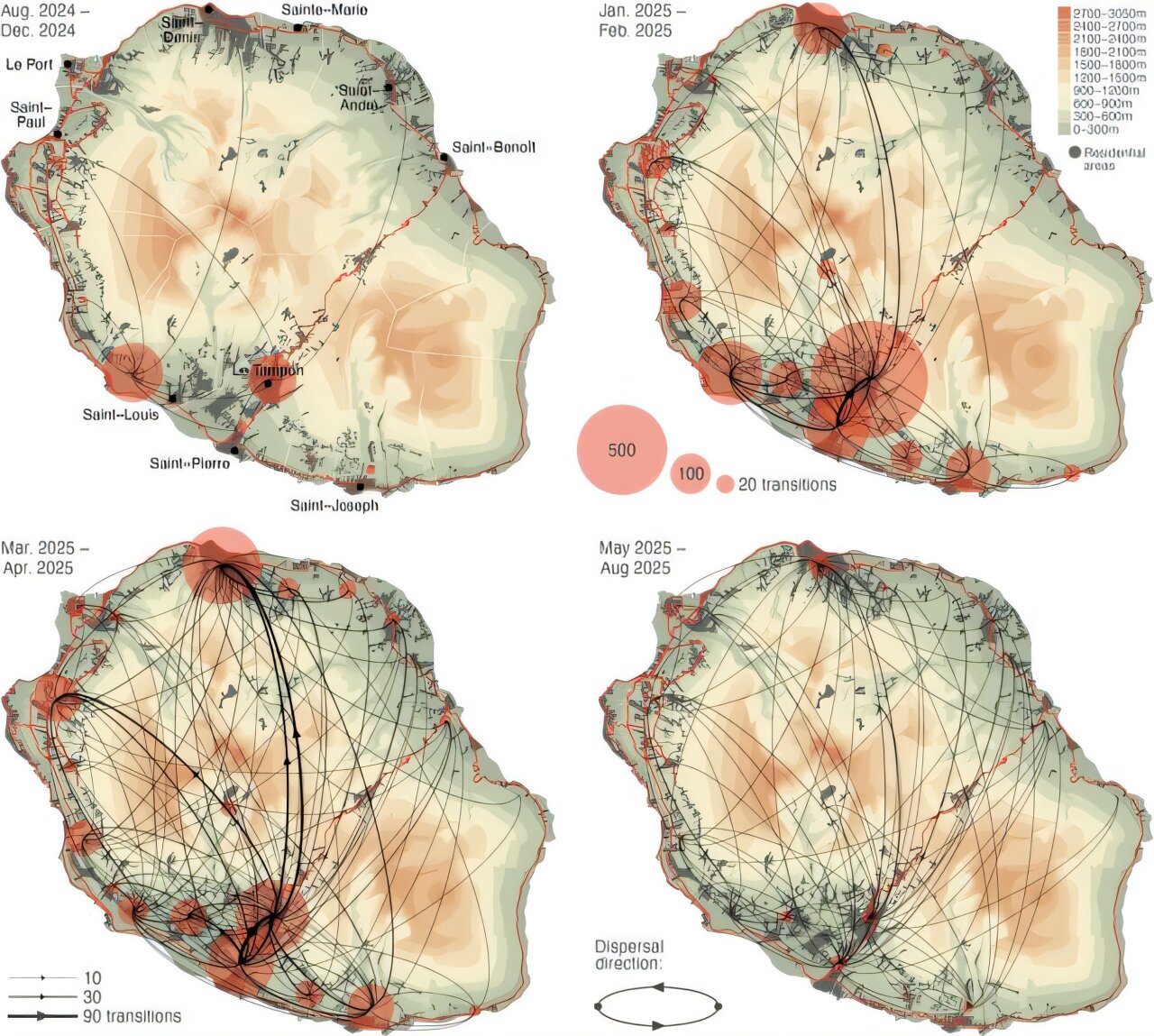
Throughout the outbreak, the associated Arbovirus National Reference Center in Réunion carried out intensive genomic surveillance, sequencing more than 3,000 near-complete viral genomes from across the island. The share of confirmed cases sequenced was comparable to that for only a handful of other pathogens, such as Ebola and SARS-CoV-2. This dataset provided a strong basis for tracking how the virus evolved, spread and eventually receded.
To make use of these data, the team of Belgian, French and American researchers applied phylodynamic and phylogeographic approaches (statistical methods that use the evolutionary relationships between viral genomes to reconstruct where and how a pathogen has traveled). The analyses indicate that the epidemic likely stemmed from a single introduction and that the virus then circulated in a highly intermixed fashion, with frequent movement between municipalities driven by human mobility and population density.
Source link