This article has been reviewed according to Science X's editorial process and policies. Editors have highlighted the following attributes while ensuring the content's credibility:
When an important area of the human brain involved in language processing is temporarily disrupted, other areas of the brain take over much of its work. Researchers at Leipzig University and the Max Planck Institute for Human Cognitive and Brain Sciences (MPI CBS) in Leipzig have shown how flexibly the brain can maintain performance even in the face of acute disruption, and how different brain networks work together in real time to achieve this. The researchers have just published their new study in Nature Communications.
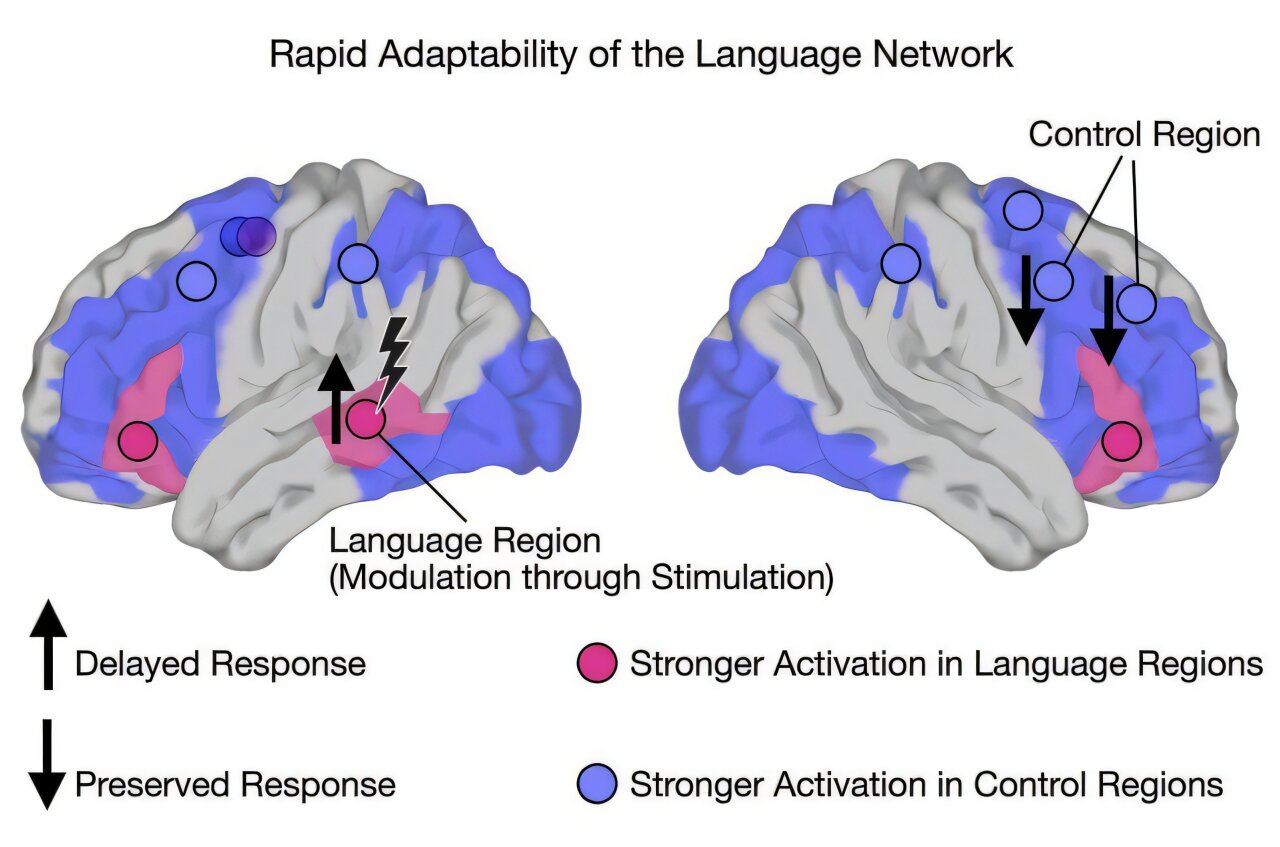
"When semantic processing is disrupted, the brain flexibly recruits additional control regions that normally perform more general functions to support language processing. This allows it to maintain performance," explains Hartwigsen. The study thus provides new insights into the brain's ability to adapt rapidly and dynamically. Until now, research has primarily established which areas of the brain are involved in language processing and how the brain adapts over the longer term.
What the researchers found particularly interesting was that they observed two opposing processes at the same time: while the language region directly affected by the disruption showed increased activity that was associated with poorer performance—reflected in slower response times—more distant control regions showed increased activity associated with better performance. This was associated with less impairment of language performance. "This suggests that disruption and compensation in the brain do not occur one after the other, but at the same time," says Hartwigsen.
Source link